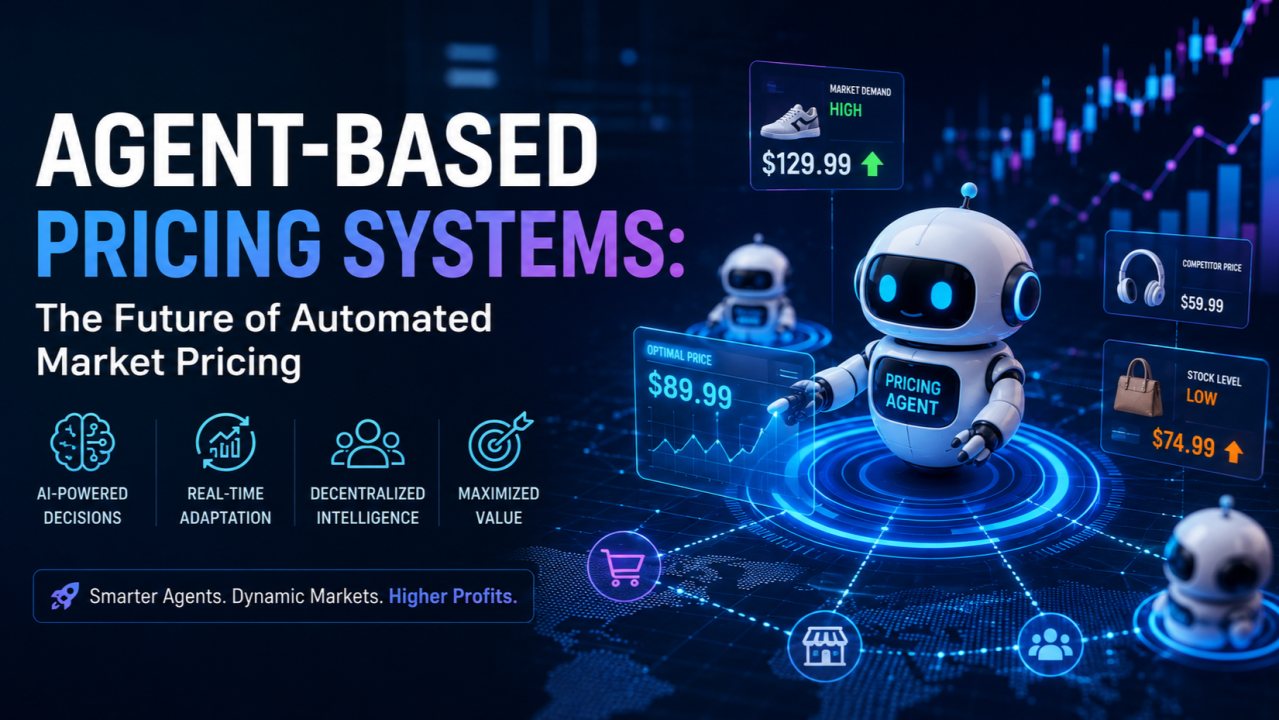
How AI pricing agents will transform retail — what retailers need to know, and how to prepare.
| $1.3T Global dynamic pricing market by 2030 | 4%+ Margin uplift from AI-optimised pricing | 15x Faster price updates vs. manual processes | 68% Of the top retailers using algorithmic pricing by 2025 |
|---|
Sources: MarketsandMarkets (2024); RapidPricer client data; McKinsey Retail Pricing Report (2024); Gartner
1. What Is an Agent-Based Pricing System?
A pricing agent is an autonomous software program that monitors market data, competitor prices, inventory levels, and customer demand — then sets or recommends prices automatically, without waiting for a human to act. Think of it as a tireless pricing analyst working 24/7 across every SKU in your assortment.
Traditional pricing works like this: a category manager reviews a spreadsheet every week, compares a handful of competitor prices, and makes adjustments. The whole cycle takes days. An agent-based system compresses that cycle to minutes — or seconds.
How a Pricing Agent Works — Step by Step
| Step | What Happens | Time Required |
|---|---|---|
| 1. Observe | Agent scans competitor prices, stock levels, demand signals | Continuous / real-time |
| 2. Model | Demand elasticity calculated per SKU, per store zone | < 60 seconds |
| 3. Optimise | Prices adjusted to hit your target: margin, volume, or share | < 5 minutes |
| 4. Guard | KVI items, image products, and price families protected | Simultaneous |
| 5. Execute | Recommended prices pushed to POS or e-commerce platform | < 30 minutes |
2. The Retail Pricing Problem Agent Systems Solve
Most retailers are leaving money on the table. Not because they have bad products — but because they price by gut feeling, last year's rules, and weekly spreadsheets that can't respond to today's market.
The Cost of Manual Pricing — By the Numbers
| Category | Impact on Retail Performance | Value |
|---|---|---|
| Margin lost to mispricing | █ | 4.2x / % |
| SKUs actively monitored (manual) | ████ | 12x / % |
| SKUs monitored (AI system) | ██████████████████████████████ | 100x / % |
| Price update frequency (manual, weekly) | 1x / % | |
| Price updates/week (agent-based) | █████ | 15x / % |
Note: Margin figures represent typical uplift opportunity. SKU monitoring is relative (100% = full assortment). Source: McKinsey (2024), RapidPricer
| Real Retailer Example: Grocery Chain, 1,200 SKUs A regional grocery chain with 1,200 SKUs was manually updating prices every 2 weeks. After deploying an agent-based pricing system (RASPER), they moved to daily optimisation. In the first 12 weeks: margin on fresh produce improved by 3.8%, stockouts on slow-moving items fell by 22%, and the pricing team's workload dropped by 60%. They didn't need to hire a single additional person. |
|---|
3. Types of Pricing Agents in Use Today
Not all pricing agents are equal. They differ in the signals they use, the speed at which they respond, and how much autonomy they have. Here is a practical breakdown:
| Agent Type | How It Works | Best For | Risk Level |
|---|---|---|---|
| Rule-Based Agent | Follows fixed rules (e.g., always undercut competitor by 2%) | Entry-level automation | Low |
| Elasticity-Optimiser | Uses price-demand curves per SKU to hit margin/volume targets | Category-level optimisation | Low-Med |
| Reinforcement Learning (RL) Agent | Learns from trial-and-error what prices maximise reward | E-commerce, high-frequency markets | Medium |
| LLM-Powered Agent | Uses large language models to reason about context, news, and seasonality | Complex multi-signal pricing | Medium-High |
| Multi-Agent System | Multiple agents negotiate or compete across categories or zones | Enterprise retail, marketplaces | High |
Source: RapidPricer analysis; Gartner AI Pricing Landscape (2024); academic classification from Calvano et al.
4. The RapidPricer Approach: Science, Not Guesswork
RapidPricer's RASPER platform is built on elasticity-based optimisation — the most evidence-grounded approach to retail pricing. Here is what makes it different from generic AI pricing tools:
| Feature | Generic AI Tool | RASPER / RapidPricer |
|---|---|---|
| Price elasticity | Category-level averages | Per-SKU, per-zone elasticity models |
| KVI / Image item protection | Manual exclusions | Automatic guardrails built-in |
| Competitor monitoring | Spot-check scraping | Continuous scraping + signal integration |
| Transparency | Black box output | Full method visibility, explainable decisions |
| Objective setting | Fixed (cheapest / margin) | Configurable: margin, volume, or share |
| Human-in-loop | Minimal | The category manager reviews before execution |
5. What Retailers Should Do Now
Agent-based pricing is no longer experimental. 68% of top-tier retailers will be using some form of algorithmic pricing by the end of 2025 (Gartner). The question is not whether to adopt it, but how to do it responsibly.
A Practical 4-Step Readiness Roadmap
- Audit your current pricing process. How often do prices update? How many SKUs are actively managed? Where are you most exposed to competitor moves?
- Run a Pricing Health Check. Before committing to a platform, get a structured assessment of where your prices are leaving margin or losing volume. RapidPricer's Health Check starts from €5,000 and runs on your actual data under NDA.
- Start with a scoped pilot. Test agent-based optimisation on 1–2 categories (ideally a high-volume, elastic category like beverages or household). Measure margin uplift versus a control group.
- Scale with guardrails. Once the method is validated, extend across the assortment — but always with KVI protection, price family rules, and human review of outlier recommendations.
| What the Numbers Show Across RapidPricer Engagements Across 4 optimisation waves on a leading pharmacy & convenience chain: 1,498 stores enrolled | 7 product categories | 28 regional zones | Modelled margin uplift of +1.2% to +9.3% per category per wave. Every category, every wave showed positive modelled margin improvement. (Source: RapidPricer Proof Page, 2025) |
|---|
Sources & Further Reading
- Calvano, E. et al. (2020). Artificial Intelligence, Algorithmic Pricing and Collusion. American Economic Review.
- McKinsey & Company (2024). Pricing in Retail: Setting Strategy, Realising Value.
- Gartner (2024). AI in Retail Pricing: Market Guide.
- MarketsandMarkets (2024). Dynamic Pricing Market — Global Forecast to 2030.
- Gange, K. (2023). The Expert Guide to Retail Pricing. Routledge.
- RapidPricer (2025). Proof: Pharmacy & Convenience Chain Case Study. www.rapidpricer.com/proof
"AI-Generated Content Disclaimer
This content was generated in part with the assistance of artificial intelligence tools. While efforts have been made to review, edit, and ensure the accuracy, completeness, and reliability of the content, it may still contain errors or omissions. It should not be considered professional advice, and users should independently verify any information before making decisions based on it. The publisher/author assumes no responsibility or liability for any consequences resulting from reliance on this content."
- The World Cup Will Break Your Pricing. Are You Ready?
- The Third-Party Delivery Margin Trap
- The Always-On Shelf: How Real-Time Competitive Data Is Rewriting Retail Pricing
- Why Most Grocers Leave 200–300 bps on Perishables—and What the Digital Product Passport Will Force Them to Fix
- The Always-On Shelf: How Real-Time Competitive Data Is Rewriting Retail Pricing
- The Third-Party Delivery Margin Trap
- The Pricing DD Blind Spot: How Much Margin Are PE-Backed Food Retailers Really Leaving on the Floor
RapidPricer helps automate pricing and promotions for retailers. The company has capabilities in retail pricing, artificial intelligence, and deep learning to compute merchandising actions for real-time execution in a retail environment.