Category timing, KVI discipline, and bundle economics for a season squeezed by tariffs
Back-to-school is retail's dress rehearsal for the winter holidays — smaller in dollars, run on a tighter clock, and operating on a thinner margin in good years. This year it is also running against a tariff bill that landed squarely on the items every parent can price from memory: index cards are up 42.6% year over year, notebooks up 17.1%. A retailer who answers that with a uniform cost-plus markup is choosing exactly the wrong few points of margin to protect.
The good news is that back-to-school is one of the best-instrumented seasons in retail. NRF and Deloitte have surveyed the same families for two decades, and the patterns hold steady enough to plan against. This playbook works through three of them — when each category actually gets bought, which items are quietly carrying the store's price image, and how a well-built bundle absorbs cost pressure without anyone noticing — using this year's tariff data and the most recently published survey cycle as the evidence base.
Two Surveys, One Season
Start with the number everyone quotes and few reconcile. NRF and Prosper Insights put 2025 K-12 back-to-school spend at $39.4 billion, up from $38.8 billion the year before. Deloitte's parent-panel survey, fielded a few weeks earlier each cycle, puts the same season at $30.9 billion, essentially flat. Both are credible. Neither is wrong. They measure different populations with different instruments: NRF surveys a broad consumer sample that includes grandparents and gift-givers; Deloitte surveys only parents budgeting for their own children. The roughly 25% gap between the two is the gap between total category demand and core parent wallet — and a pricing team that doesn't know which population its own customer base resembles will plan against the wrong number.
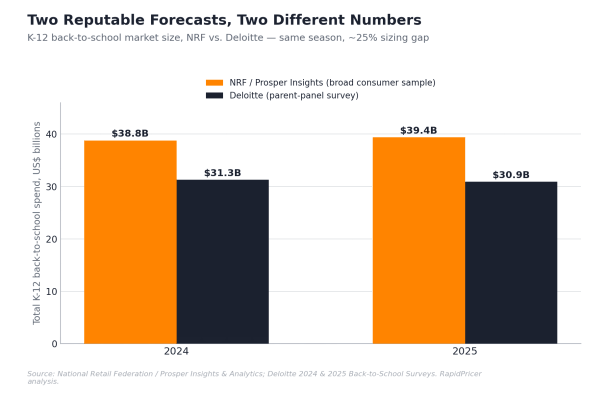
The more useful read isn't either total — it's the direction both agree on. Per-student spend eased in both surveys from 2024 to 2025 even as total spend held roughly flat, which only happens one way: more households shopping the category, each spending a little less. That is a participation-driven season, not a basket-inflation one, and it rewards retailers who win share of shoppers over retailers who try to extract more from the same shopper.
Deloitte's data adds a second wrinkle worth carrying into the rest of this playbook: lower-income households (under $50K) plan to spend 10% more this year, while middle- and higher-income households plan to spend 7–9% less. The “average” shopper this season is being pulled less by income growth and more by necessity spending among households with the least room to absorb tariff-driven price increases — precisely the segment most likely to comparison-shop the items covered in the KVI section below.
Inside that total, the dollars concentrate unevenly across categories — and not in the categories carrying the heaviest 2026 cost pressure.
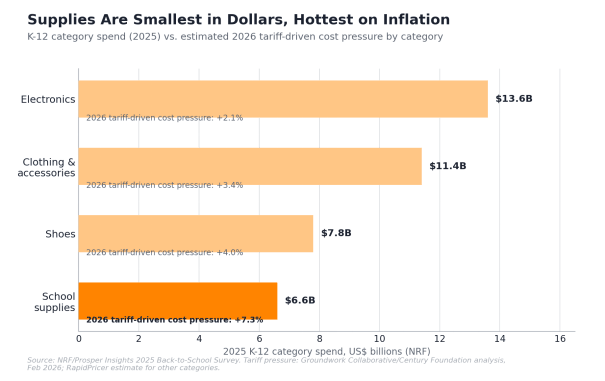
Electronics is the largest line item in dollars but the least tariff-exposed of the four; school supplies is the smallest line item and the most exposed, by a wide margin. That mismatch — small category, outsized cost shock — is exactly why supplies deserve a disproportionate share of pricing attention this cycle, even though they'll never be the biggest number on a category P&L.
Category Timing: Four Clocks, Not One
The instinct in most back-to-school planning is to build a single promotional calendar — discount everything for the same three or four weeks. The survey data describes four overlapping seasons running on four different clocks instead.
Dorm and college setup moves first and fastest: shipping furniture and booking move-in logistics force the decision months ahead, and the large majority of that spend is committed before the first week of August. School supplies move next, tracking closely with the 67% of shoppers who told NRF they had already started buying by early July last cycle — the highest early-shopping share since NRF began tracking it in 2018, and a direct response to tariff anxiety. Electronics lag supplies by two to three weeks, clustering around Prime Day and the mid-July retail events, because shoppers are willing to wait a little longer for a deal on a bigger-ticket item. Apparel and footwear move last: sizing, weather, and what's actually trending that term can't be locked in early, so a meaningful share of that category's spend lands in the final two weeks before school starts.
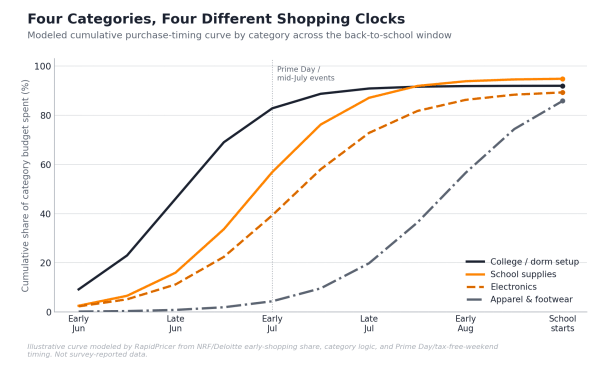
The pricing implication is specific, not directional. A single markdown calendar either burns margin on categories that would have converted anyway — discounting supplies in early June, before the tariff-anxious shopper even needed the push — or it ends too early and misses the apparel rush entirely. Stagger the calendar to the category, not the season.
KVI Sharpening: Protect the List Tariffs Are Attacking
This is the section that matters most this cycle, because the 2026 tariff bill on imported school supplies didn't land evenly. It concentrated on exactly the items shoppers price from memory.
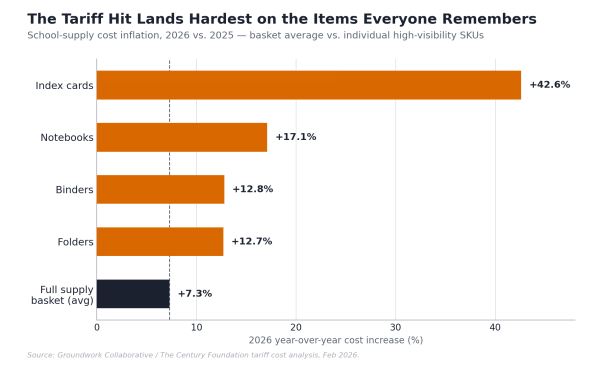
Index cards, arguably the single most price-anchored item on a typical supply list, are up 42.6%. Notebooks are up 17.1%. Binders and folders are each up roughly 13%. The full supply basket, blended, is up 7.3% — nearly three times headline inflation. One major colored-pencil manufacturer put the underlying problem plainly when asked whether a domestic plant could absorb the new tariff on its imported wood: the supply simply doesn't exist in the U.S., so the added cost has nowhere to go but the shelf price. A retailer who passes that 7.3% through evenly ends up holding the line on items nobody checks and raising the price on the four or five SKUs that anchor an entire store's price image in a parent's head.
This is the textbook case for a disciplined Known Value Item list. Plot back-to-school items on price visibility against margin headroom and the map is unambiguous:
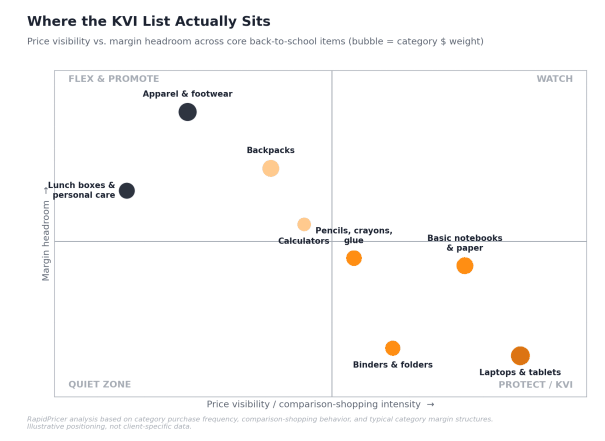
Basic notebooks, pencils, glue, binders, folders, and entry electronics sit in the high-visibility, low-margin-headroom quadrant — the items that get remembered, repeated, and compared across three stores in the same afternoon, and the same items currently absorbing the steepest tariff hit. Backpacks, calculators, lunch boxes, personal care items, and most of apparel sit in the opposite quadrant: bought less frequently, harder to comparison-shop precisely because style and fit vary by retailer, and carrying real margin headroom.
The discipline isn't “hold every price.” It's hold the dozen prices doing the price-image work, and let the tariff cost flow through everywhere else, where shoppers are weighing value rather than memorizing price. Retailers who try to protect margin uniformly across the assortment end up protecting it nowhere that matters and giving it up everywhere a shopper would have noticed anyway.
Bundle Logic: Recovering Margin Without the Sticker Shock
Once the KVI list is frozen, the cost pressure has to be recovered somewhere — and bundling is the mechanism that lets a retailer hand a shopper a number that feels generous while moving very little actual margin.
The mechanics are simple in outline: anchor the bundle on the lowest-margin item — typically the one driving footfall, like a backpack — and attach it to two or three higher-margin companions a parent already needs, such as a supply kit and a lunch box.
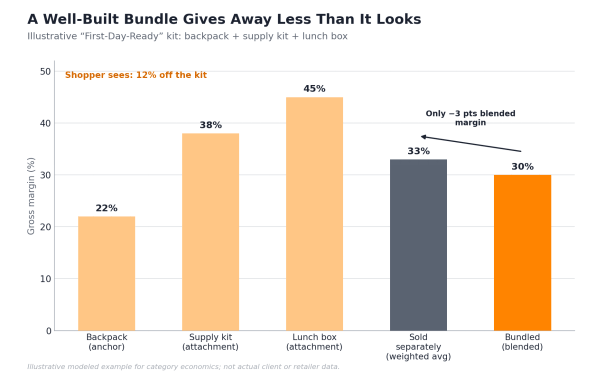
Priced separately, those three items carry a blended margin in the low thirties. Priced as a “First-Day-Ready” kit at a double-digit headline discount, the blended margin gives up only a few points — not the full size of the discount — because the markdown is calculated against the anchor's already-thin margin and partly offset by full-margin attachment volume the basket wouldn't otherwise have captured in one trip.
This is also where this year's value-seeking behavior becomes useful rather than just defensive. Three in four parents surveyed by Deloitte say they'll switch brands or retailers if their preferred option gets too expensive, and the average shopper plans to visit five retail formats this season. A bundle gives that exact shopper a reason to complete the whole basket in one place instead of splitting it across a discount store for supplies and a mass merchant for the backpack — converting comparison-shopping behavior into basket consolidation, which is worth more to margin than any single line-item discount.
The Back-to-School 2026 Checklist
• Size the season against your own customer, not a headline number. If your shopper looks like Deloitte's parent panel, plan against roughly $570 per child — not NRF's broader $858.
• Build four promotional calendars, not one — dorm/college, supplies, electronics, apparel — each timed to its own purchase curve rather than a single back-to-school “event.”
• Freeze the dozen items doing your price-image work — basic notebooks, pencils, glue, binders, folders, entry electronics — even as landed cost rises, and let the tariff pass-through happen where there's real margin headroom instead.
• Build at least one anchor-plus-attachment bundle per core need (first-day-ready, dorm starter, homework station), priced against the blended margin rather than the headline discount.
• Expect the early-shopping curve to repeat or steepen. With 67% of shoppers already underway by early July last cycle and tariff anxiety higher this year, mid-July promotional windows matter more than late-August clearance.
None of this requires guessing. It requires knowing, at the SKU level, which prices a shopper actually remembers and which ones they don't — the same per-SKU elasticity discipline that separates a margin plan from a markup policy. If you want a read on where your own back-to-school assortment is leaking margin or losing volume, a Pricing Health Check is a fixed-scope way to find out before the season locks in.
- The World Cup Will Break Your Pricing. Are You Ready?
- The Third-Party Delivery Margin Trap
- The Always-On Shelf: How Real-Time Competitive Data Is Rewriting Retail Pricing
- Why Most Grocers Leave 200–300 bps on Perishables—and What the Digital Product Passport Will Force Them to Fix
- The Always-On Shelf: How Real-Time Competitive Data Is Rewriting Retail Pricing
- The Third-Party Delivery Margin Trap
RapidPricer helps automate pricing and promotions for retailers. The company has capabilities in retail pricing, artificial intelligence, and deep learning to compute merchandising actions for real-time execution in a retail environment.