
Introduction
In today’s competitive and fast-paced market, pricing is no longer a straightforward exercise of cost-plus-margin. Instead, it has evolved into a complex, data-driven discipline that balances quantitative precision with human behavior. As customers interact with brands across multiple channels and become increasingly aware of pricing strategies, retailers and businesses must look beyond traditional metrics like revenue and margin.
According to a 2024 McKinsey report, companies that use behavioral pricing strategies outperform competitors by 5-8% in margin growth. Meanwhile, Salesforce’s global survey showed that 57% of consumers changed brands in the past year due to pricing perceptions, not actual cost. This highlights the growing importance of aligning pricing with psychological expectations.
This article explores how pricing metrics are evolving to reflect new customer expectations, and how psychological principles—such as perceived value, fairness, and bias—can be leveraged to design more effective pricing models. By integrating customer psychology into pricing analytics, organizations can unlock powerful advantages in customer loyalty, conversion, and lifetime value.
1. The Shift from Traditional to Evolving Pricing Metrics
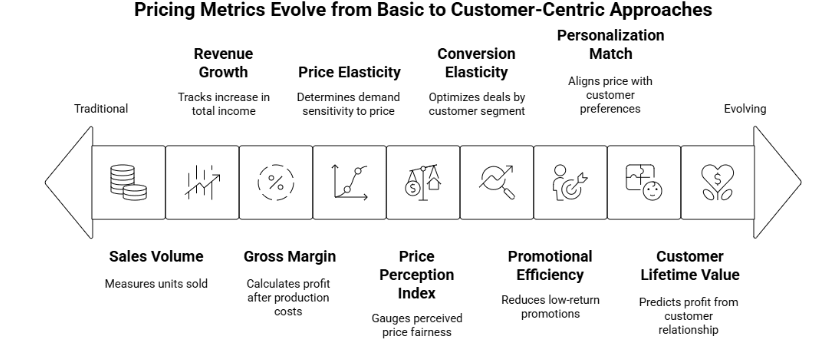
Figure 1: Pricing Metrics Evolve from Basic to Customer-Centric Approaches
Historically, pricing success was measured using basic indicators like:
● Sales Volume
● Revenue Growth
● Gross Margin
● Price Elasticity
While still relevant, these lagging indicators fail to capture nuanced consumer behaviors, competitive responses, and contextual variables like weather, time of day, or digital touchpoints. Today’s evolving pricing metrics are more holistic, real-time, and customer-centric.
Modern Pricing Metrics Now Include:
| | | | | :-: | :-: | :-: | | **Metric** | **Definition** | **Real-World Example** | | **Customer Lifetime Value** | Total net profit expected from a customer over time | **Amazon Prime** users spend **2.5x** more than non-members due to pricing trust. | | **Price Perception Index** | Measures fairness and competitiveness perception | **Aldi’s “Everyday Low Prices”** strategy scores high on price perception indexes. | | **Conversion Elasticity** | How pricing changes affect conversion rate across segments | **Booking.com** uses this to optimize last-minute deals by customer segment. | | **Promotional Efficiency** | Sales uplift vs. margin erosion from promos | **Target** uses promo scoring to reduce low-return promotions by 20%. | | **Personalization Match** | Alignment between offered price and customer preferences | **Spotify Premium** offers localized pricing (e.g., student/family plans) based on usage. |
2. Why Customer Psychology Matters in Pricing
Consumers do not evaluate price in a vacuum—they anchor it to previous experiences, competitor pricing, emotional states, and subconscious biases. Understanding how people feel about prices can be more powerful than knowing what they pay.
Key Psychological Factors at Play:
| | | | | :-: | :-: | :-: | | **Concept** | **Description** | **Example** | | **Anchoring Bias** | Initial price seen influences future value perceptions | **Apple** introduces a high-end iPhone first to anchor lower-tier sales. | | **Charm Pricing** | Prices ending in .99/.95 feel cheaper | A product at **$4.99** outsells the same one at **$5.00** by 20%. | | **Decoy Effect** | Inferior pricing tiers push users to a better but more expensive option | **The Economist**'s famous print+web bundle priced to upsell. | | **Fairness Perception** | Consumers punish perceived unfairness in price | **Uber** faced backlash during surge pricing in natural disasters. | | **Loss Aversion** | People fear loss more than they value gain | **Retailers use "Last Chance"** labels to create urgency. |
3. The Integration of Psychology & Metrics
Successful pricing strategies today blend hard data with behavioral insight. This requires integrating psychological principles into pricing models and measuring their outcomes using smart KPIs.
| | | | | :-: | :-: | :-: | | **Psychological Tactic** | **Metric to Track** | **Brand Example** | | Charm Pricing (.99/.95) | Conversion Rate, A/B Test Results | **Walmart** uses charm pricing across its categories. | | Decoy Pricing | Upsell Ratio, Tier Skew | **Netflix’s “Standard” plan** drives higher upgrades. | | Dynamic Anchoring | Bounce Rate, Session Time | **Booking.com** displays fake “original prices.” | | Bundling/Upselling | Average Order Value (AOV) | **McDonald’s “Extra Value Meal”** increases AOV. | | Personalized Discounts | CLV, Purchase Frequency | **Sephora** customizes pricing for loyalty tiers. |
4. AI and Predictive Psychology in Pricing
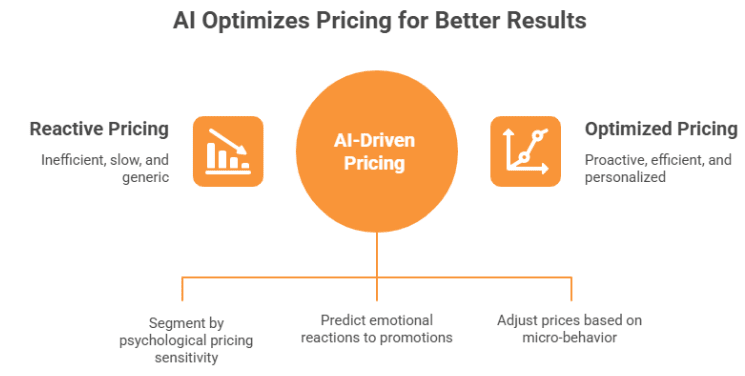
Figure 2: AI Optimizes Pricing for Better Results
With the advent of AI and machine learning, retailers and platforms can simulate how different prices might psychologically impact different segments before going live. According to a 2023 Gartner study, 65% of retailers using AI-based pricing observed a 10–15% improvement in conversion rates. AI models are increasingly able to:
● Cluster customers based on psychological pricing sensitivity
● Predict emotional reactions to promotions using sentiment data
● Adjust prices in real-time based on intent, time, and micro-behavior
● Identify thresholds where price resistance spikes
This predictive layer gives pricing teams a proactive edge, moving from reactive markdowns to psychologically optimized pricing scenarios.
Example: Zalando, a leading European fashion platform, uses AI to test and adjust prices every 15 minutes based on shopper micro-behaviors, leading to a 20% increase in margin and 12% higher retention.
5. Omnichannel Considerations: Psychology Across Touchpoints
Customer psychology doesn't stop at the shelf or screen. Pricing perceptions are shaped differently across physical and digital channels:
| | | | | :-: | :-: | :-: | | **Channel** | **Psychological Insight** | **Example** | | **Mobile App** | High impulsivity, visual FOMO, flash deal impact | **Shein** uses time-limited discounts to increase urgency. | | **In-Store** | Visual anchoring, shelf position matters | **Costco** places high-margin items at eye level. | | **Email** | Anchors future pricing perception | **Wayfair** sends email-only “exclusive” markdowns. | | **Voice/AI** | Simpler pricing wins | **Alexa Deals** emphasize convenience and value with round pricing. |
Consistency in psychological pricing tactics across channels ensures stronger brand trust and less cognitive dissonance.
6. Challenges & Ethical Considerations
The rise of dynamic and psychological pricing has sparked debate around fairness and consumer manipulation. Regulators are increasingly scrutinizing tactics like:
● Drip Pricing: Hidden fees (banned in parts of EU/UK).
● Surge Pricing: Common in ride-sharing, but controversial during crises.
● Personalized Pricing without Disclosure: Violates transparency expectations.
Stat Snapshot: A 2023 PwC survey found that 72% of consumers would stop buying from a brand they believe uses unfair pricing tactics, showing that ethics must be embedded into strategy.
Ethical pricing practices should prioritize:
● Transparent discounting
● Consent for personalized offers
● Responsible use of AI
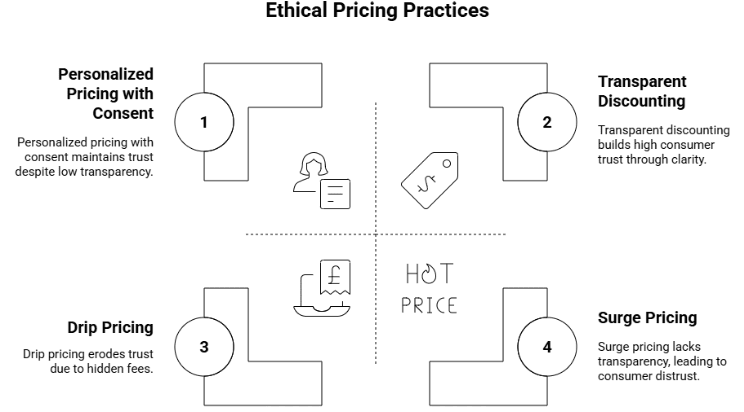
Figure 3: Ethical Pricing Practices
7. The Future: Emotion-Driven Dynamic Pricing?
We’re heading toward a world where real-time emotion detection (via facial recognition, sentiment analysis, or wearables) could influence pricing in the moment. A stressed customer might be offered simpler bundles; a loyal, happy customer could see personalized value-based pricing that strengthens brand love.
While still speculative, the infrastructure for emotion-linked pricing is rapidly emerging, demanding a rethinking of how we define "fair price" in a hyper-personalized world.
Conclusion
Pricing is no longer just a mathematical exercise. It’s a delicate blend of metrics, consumer psychology, and technology. The businesses that master this trifecta—using evolving KPIs, ethically applying behavioral science, and leveraging AI—will not only win wallets but also minds and hearts.
As pricing evolves, so must our tools and thinking. The future belongs to pricing leaders who are as fluent in psychology as they are in spreadsheets.
Read More On
● Global E-Commerce Evolution: A Post-Pandemic Catch-Up on Who’s Winning the Online Retail Race
● Pricing Transformation: From Manual Models to Autonomous Intelligence
● Invisible Influencers: How AI Detects Non-Obvious Pricing Triggers Like Social Trends & Weather
● Why Pricing is the Anchor of Retail Strategy
● The Future of Retail in Europe: Who Will Win?
● The Evolution of European Retail: Pre, During, and Post-Pandemic
● Retail Media: Connecting Pricing Intelligence with Monetization
About RapidPricer
RapidPricer helps automate pricing and promotions for retailers. The company has capabilities in retail pricing, artificial intelligence, and deep learning to compute merchandising actions for real-time execution in a retail environment.
Contact info:
Website:
LinkedIn:
Email: info@rapidpricer.nl