
Bayesian pooling and transfer learning for slow movers and new items
Most SKUs in a retail assortment never accumulate enough clean, price-varying sales history to support a reliable, item-specific elasticity estimate. New items, seasonal introductions and long-tail slow movers make up the majority of most catalogs by SKU count, yet they are exactly where naive statistical estimation is weakest. This note lays out the estimation problem in analytical terms, quantifies how badly naive per-item models perform under realistic data constraints, and walks through the pooling and transfer-learning approach RASPER uses to produce stable, defensible elasticities for thin-data items.
| Key takeaways A single-item elasticity fit on four weeks of history is, on average, off by more than a full elasticity point — and roughly one in eleven such estimates is off by more than five points, wild enough to break a repricing rule. Partial pooling toward a category-level prior cuts typical estimation error by 82% for brand-new items and by 66% for slow movers, while barely touching well-estimated, established SKUs. Reliable single-item estimation only kicks in past roughly twelve to sixteen weeks of price-varying history; below that, the estimate is mostly noise. For items with zero history, blending a category prior with an attribute-based prior (price tier, discretionary vs. staple positioning, pack format) outperforms both a flat category average and a single global elasticity by a wide margin. Pooling is a bias-variance trade, not a free lunch — it needs guardrails: minimum sample sizes for prior formation, category definitions that are behaviorally coherent, and a floor under how far any one item's price can move on a borrowed estimate. |
|---|
The thin-data problem
Elasticity estimation is a data-hungry exercise by nature. To separate a price effect from ordinary demand noise — weather, seasonality, local stockouts, competitor moves, basket effects — a model needs to observe a product's price moving across a meaningful range, repeatedly, while everything else is held roughly constant. Category leaders and top-selling staples generate that kind of history within a few months. The long tail does not.
In a typical grocery, pharmacy or specialty retail assortment, somewhere between half and three-quarters of active SKUs by count fall into one of two thin-data classes: items launched in the last one to three months, and slow movers that sell only a handful of units per week even after a year on shelf. Both classes share the same statistical symptom — too few independent price-quantity observations to pin down a slope with any confidence — for different commercial reasons. New items lack history because they haven't existed long enough; slow movers lack it because their weekly volume is too thin to generate usable price variation even over a long window.
The instinctive fix — fit a regression on whatever data exists, however little — is where most self-built pricing tools go wrong. The next two sections quantify exactly how wrong.
Why naive per-item estimation breaks down
To make the failure mode concrete, we simulated a synthetic assortment of 900 SKUs spread across six category archetypes — grocery staples, OTC health, personal care, private label, front-of-store impulse and seasonal — each with its own underlying elasticity profile, from close to inelastic staples through highly elastic seasonal and impulse categories. For every item we generated a true, hidden elasticity together with a weekly price and sales history, then split the assortment evenly into three data-availability tiers: new items with four weeks of history, slow movers with twelve weeks, and established items with a full year. This gives a controlled setting where the truth is known and every estimation method can be scored against it directly.
Fitting a standard item-level regression to each SKU's own price and quantity history — the default approach in most spreadsheet-based or off-the-shelf pricing tools — produces a clear and fairly severe pattern. On the four-week new-item tier, the typical (median) estimation error is over a full elasticity point, and roughly one estimate in eleven is off by more than five elasticity points — the kind of outlier that would tell a category manager a staple item is more price-sensitive than the most discretionary impulse buy in the store, or vice versa. Those outliers are not evenly distributed noise; they come from the handful of items where, by chance, the observed prices barely moved during the sample window, so the regression is dividing a small signal by an even smaller denominator and the resulting slope swings wildly.
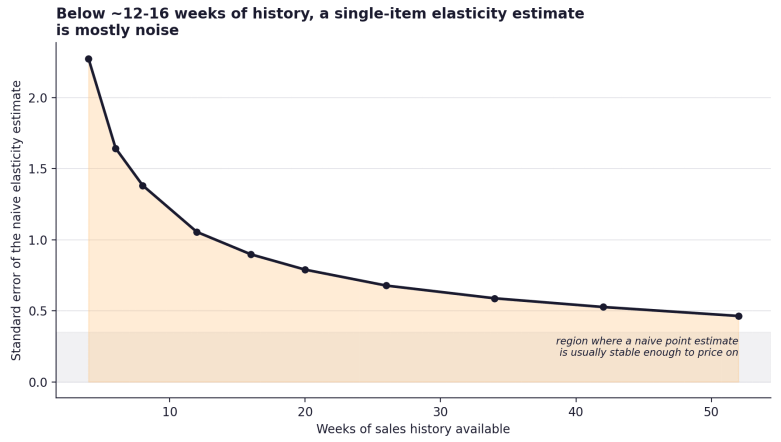
The twelve-week slow-mover tier is better but still fragile: typical error drops to roughly two-thirds of an elasticity point, still large enough to misclassify a moderately elastic item as inelastic (or the reverse) a meaningful share of the time. Only once an item accumulates close to a full year of price-varying history does the naive estimate settle down to a level most pricing teams would consider workable on its own. That threshold — somewhere in the twelve-to-sixteen-week range before a per-item estimate is more signal than noise — is the practical dividing line RASPER uses to decide when an item is allowed to "speak for itself" statistically and when it needs help from its neighbors.
Borrowing strength: partial pooling
The statistical fix is not to throw the item-level estimate away, and not to replace it with a flat category average either — both are lossy in opposite directions. A pure item-level estimate ignores everything RASPER already knows about how similar products behave. A pure category average ignores the fact that even four weeks of an item's own data carries some information, and it erases real differences between items inside the same category. Bayesian partial pooling sits between the two: each item's final elasticity is a weighted blend of its own noisy estimate and a category-level prior, where the weight given to the item's own data grows automatically as that data becomes more precise.
In practice, the weighting comes from comparing two variances: how much true elasticities genuinely differ from one item to the next inside a category (the category's natural spread), against how uncertain any single item's own regression estimate is, given how little data it has to work with. An item with very little history, or with price history that barely moved, gets an estimate dominated by uncertainty — so it gets pulled hard toward the category's typical behavior. An item with a longer, well-varied price history has a precise estimate of its own, so its final elasticity stays close to what its own data says, adjusted only lightly by the category prior. Established SKUs, in other words, keep their own personality; thin-data SKUs borrow it from their category until they've earned enough history to diverge.
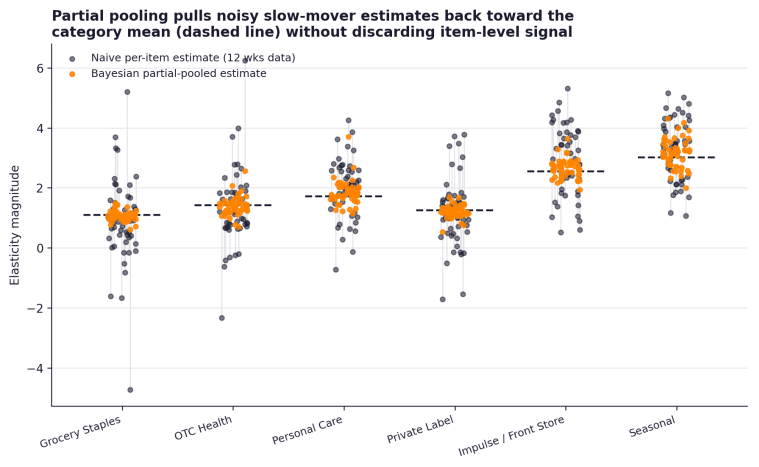
The category priors themselves are not assumptions — they are estimated from the assortment's own established, well-measured SKUs, then treated as an anchor for everything with thinner data. That keeps the whole system self-consistent and specific to the retailer's actual category structure and price positioning, rather than importing generic industry elasticity benchmarks that may not reflect the client's format, geography or customer base.
What pooling actually buys you
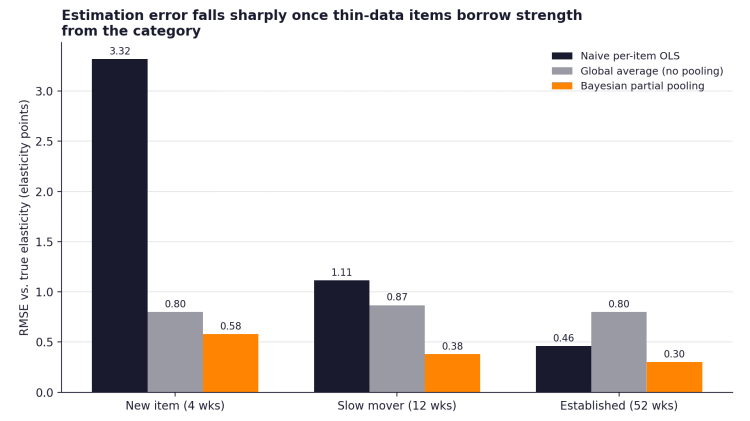
Scoring every method against the known, simulated truth for each of the three data-availability tiers makes the payoff concrete.
| Data tier | Naive OLS | Global average | Partial pooling | Error reduction vs. naive |
|---|---|---|---|---|
| New item (4 wks) | 3.32 | 0.80 | 0.58 | −82% |
| Slow mover (12 wks) | 1.11 | 0.87 | 0.38 | −66% |
| Established (52 wks) | 0.46 | 0.80 | 0.30 | −34% |
Table 1. RMSE against true elasticity (elasticity points), by method and data tier, across 300 simulated SKUs per tier.
Two results stand out. First, the size of the gain scales inversely with how much data an item has — exactly where pooling is needed most, it delivers the most. New items see error cut by more than four-fifths; established items, which barely needed help, still see a real but much smaller gain of about a third, because even a year of history is noisier than the combined signal of an entire category. Second, a flat global average — the common fallback when a pricing team doesn't trust a thin-data item's own regression — is a poor substitute for category-aware pooling: it outperforms the naive estimate only on the worst-off new-item tier, and is actually worse than doing nothing for established items, because it throws away real, well-measured category differences in elasticity between, say, seasonal impulse buys and everyday staples.
Beyond category: transfer learning for zero-history items
Category priors solve most of the problem, but a genuinely new item — first day on shelf, no sales history at all — still needs a starting elasticity from somewhere. Category alone is a reasonable first pass, but it ignores a second layer of signal that generalizes across category lines: attributes like price tier, pack format, and whether an item sits in discretionary versus staple purchase territory tend to predict elasticity at least as strongly as category membership does, and that pattern holds across the whole assortment, not just within one aisle.
We tested this by building a second, cross-cutting prior based on a simple discretionary-versus-staple flag, estimated the same way as the category priors — from established items only, pooled across every category rather than within one. Blending the category prior with this attribute-based prior, rather than relying on category alone, cut estimation error for new items by a further 45% relative to a flat global average, and outperformed category-only pooling on the harder new-item tier as well. The intuition is straightforward: a newly launched private-label snack has more in common, elasticity-wise, with other discretionary impulse items across the store than with the private-label staples that happen to share its category label. Transfer learning lets RASPER borrow from the right neighbors, not just the nearest label.
This is the same principle behind modern transfer learning in machine learning more broadly — reusing structure learned in a data-rich setting (here, the assortment's well-measured established items) to bootstrap performance in a data-poor one (a brand-new SKU) — applied to a much smaller, more interpretable feature set than a typical ML transfer-learning application. That interpretability matters commercially: a pricing analyst can see exactly which attributes and which comparison items produced a new item's starting elasticity, and challenge it if it doesn't match category knowledge.
Building this into RASPER
Turning this into a production estimation pipeline means making a handful of design choices explicit rather than leaving them implicit in a one-off script:
• Hierarchy design. Priors are built at multiple levels — category, sub-category, and a cross-cutting attribute layer (price tier, discretionary flag, pack format, private-label status) — so an item can borrow from whichever level has the most relevant, best-estimated signal, not just its immediate category.
• Minimum sample thresholds for prior formation. A category or attribute prior is only trusted once it is itself built from enough established, well-measured items; thin categories inherit from a level up the hierarchy (sub-category to category, category to format) rather than producing an unreliable prior of their own.
• Automatic, not manual, weighting. The blend between an item's own data and its prior is recalculated every refresh cycle as new sales weeks arrive, so an item's elasticity gradually “graduates” from mostly-prior to mostly-its-own-data without a human having to flip a switch.
• Bounds on borrowed estimates. Any elasticity produced substantially from a prior — rather than the item's own data — is capped within a sanity range before it is allowed to drive a live price change, and flagged distinctly in the output so a pricing analyst can see at a glance which recommendations rest on strong item-level evidence versus category inference.
• Category and attribute definitions reviewed with the client. Because the whole approach depends on categories and attributes being behaviorally coherent — items inside a group actually responding similarly to price — category structure is validated against the client's own merchandising logic rather than imported wholesale from a generic taxonomy.
Where pooling should not be trusted blindly
Partial pooling is a bias-variance trade: it deliberately introduces a small, known bias — pulling every thin-data estimate a little toward the group — in exchange for a large reduction in variance. That trade is worth making almost everywhere in a long-tail assortment, but it has real limits worth stating plainly rather than glossing over.
• It assumes the category (or attribute group) is behaviorally coherent. If a category label bundles genuinely different price-sensitivity behavior — a common problem with broad or poorly maintained category trees — pooling will quietly wash out real differences instead of correcting noise.
• It is not a substitute for eventually getting real data. A new item that never accumulates meaningful price variation — because it never goes on promotion, or its price never moves — will keep leaning on its prior indefinitely, and that should be visible to whoever is reviewing pricing decisions, not hidden inside a single blended number.
• It can mask genuinely unusual items. A product that is a legitimate outlier — a true loss leader, a highly seasonal one-off, an item with an unusually loyal niche following — will be shrunk toward a category norm that doesn't describe it well. This is exactly why RASPER flags heavily-pooled estimates for review rather than presenting every number with the same confidence.
None of this argues against pooling — the alternative, treating every four-week-old SKU's noisy regression slope as ground truth, is demonstrably worse across the board, as the results above show. It argues for treating the confidence behind an elasticity number as part of the output, not an afterthought.
The takeaway
Most of a retail assortment, by SKU count, will never have enough of its own history for a reliable stand-alone elasticity estimate — that is a structural fact of long-tail retail, not a data-collection problem that better logging eventually fixes. Bayesian partial pooling, anchored by category and cross-cutting attribute priors built from the assortment's own well-measured items, turns that structural weakness into a source of strength: thin-data items get a defensible starting elasticity drawn from genuinely similar products, well-measured items keep their own signal, and every estimate carries an implicit confidence level based on how much it leaned on its neighbors versus its own history. That is what lets a pricing engine make sensible recommendations for the 100th SKU as confidently as the 1st — without pretending four weeks of data says more than it does.
Methodology note: figures in this note come from a controlled simulation — 900 synthetic SKUs across six category archetypes with known, hidden elasticities — built specifically to let every estimation method be scored against ground truth. Absolute error levels on a live retailer's data will differ with category structure, promotional cadence and demand noise; the qualitative pattern — large, concentrated gains for thin-data items, modest but real gains even for well-measured ones, and a clear threshold below which single-item estimation is unreliable — is what carries over.
- The World Cup Will Break Your Pricing. Are You Ready?
- The Third-Party Delivery Margin Trap
- The Always-On Shelf: How Real-Time Competitive Data Is Rewriting Retail Pricing
- Why Most Grocers Leave 200–300 bps on Perishables—and What the Digital Product Passport Will Force Them to Fix
- The Always-On Shelf: How Real-Time Competitive Data Is Rewriting Retail Pricing
- The Third-Party Delivery Margin Trap
RapidPricer helps automate pricing and promotions for retailers. The company has capabilities in retail pricing, artificial intelligence, and deep learning to compute merchandising actions for real-time execution in a retail environment.