
How France's disclosure decree, its copycats, and the EU's pushback reshape the economics of resizing without reputational damage
Since July 2024, resizing a product and holding its shelf price has stopped being a quiet operational decision in a growing list of markets. France started it; Hungary, Romania and Brazil already run comparable regimes; Austria's own version took effect in April 2026; Italy's has been stuck in a standoff with the European Commission since March 2025; the UK took a different route entirely. None of these rules share a design. Some fall on retailers, some on manufacturers, some on both. Some trigger on any measurable increase in the price per unit of measurement; only one has a magnitude threshold at all, and it is a narrow one. For a pricing or revenue-growth-management team running price-pack architecture across borders, that patchwork is now a hard constraint on how a pack resize gets executed — not just a labelling footnote for the legal team to handle after the fact.
| Key takeaways • Seven distinct disclosure regimes are live or imminent across Europe and Latin America as of mid-2026, and no two use the same trigger, obligor, or disclosure window — a multinational's “safe” pack change in one market can be a compliance breach in the next. • The relationship between a pack-size cut and the resulting unit-price increase is steep: with shelf price held flat, a cut of roughly 3% is already enough to clear Austria's disclosure threshold — currently the only magnitude-based safe harbor in force anywhere. • Every other regime in force (France, Hungary, Romania, Brazil) has no minimum threshold at all: any measurable reduction that raises the unit price triggers disclosure, regardless of size. • The European Commission's infringement action against Italy shows the ceiling on how prescriptive a national disclosure rule can be — per-product, on-pack mandates are vulnerable to a single-market proportionality challenge in a way that France's retailer-side, time-boxed notice has so far not been. • The defensible response is not avoiding disclosure — it is designing price-pack architecture so that a resize reads as a deliberate, communicated portfolio choice rather than a discovered concealment, before any regulator or consumer-watchdog tracker forces the disclosure for you. |
|---|
A regulatory patchwork, not a single law
France's Order of 16 April 2024, amended 28 June 2024 and in force since 1 July 2024, is the reference point most trackers cite, but it is one design choice among several, not a template every other market copied. It places the disclosure duty on the retailer, not the manufacturer: food-predominant stores over 400 square metres must post a standardised statement — giving the old and new quantity and the resulting percentage or currency increase in the unit price — on or next to any constant-quantity product that has shrunk, for two months from the date the smaller pack goes on sale. There is no minimum size of reduction that triggers the duty; any decrease that raises the price per unit of measurement counts. Breach carries an administrative fine of up to €3,000 for an individual and €15,000 for a company.
Hungary moved first, not France: Government Decree 1/2024 has required disclosure since 1 March 2024, and it is unusual in splitting the obligation — manufacturers placing a resized product on the Hungarian market must inform both the retailer and the national food-chain safety authority, while retailers carry the shelf-level notice duty. Romania followed in October 2024 with an order placing the duty squarely on the seller. Brazil's 2024 rule runs the other way, obligating manufacturers to declare a volume or weight cut directly on the label for six months. Four working regimes, four different combinations of who discloses, to whom, and for how long — before Austria or Italy even enter the picture.
Where the patchwork is heading, and where it has stalled
The timeline below plots each regime against where it actually stands today rather than where it was originally scheduled to land — because for at least one major market, those two dates have diverged twice.
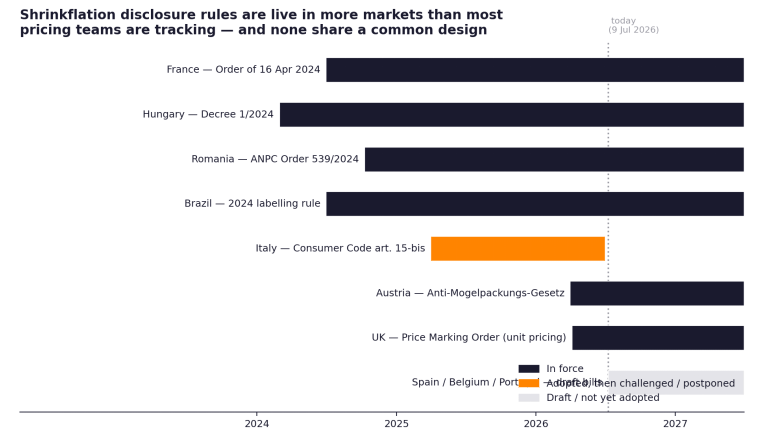
Austria's Anti-Mogelpackungs-Gesetz is the newest entrant, in force since 1 April 2026 and legislated to sunset on 30 June 2030 pending a formal evaluation of its practical impact — a built-in review clause none of the earlier regimes carry. It applies to stationary food and drugstore retailers with either more than 400 square metres of sales area or more than five branches, and, distinctively, it is the only regime with an explicit magnitude threshold: the disclosure duty only bites once a quantity reduction pushes the unit price up by more than 3%, and it does not apply at all if the manufacturer has already disclosed the change clearly on the pack itself.
Italy tells the more cautionary story. Its Consumer Code amendment (Article 15-bis, inserted by the 2024 Annual Competition Law) placed the duty on manufacturers directly — a stricter design than France's retailer-side notice — requiring the statement to appear on the pack's own main visual field for six months. The European Commission opened infringement proceedings in March 2025, arguing the per-product labelling mandate was disproportionate under the EU's single-market transparency rules and that less restrictive alternatives, such as in-store signage near the product rather than on it, were available and not adequately considered. Italy pushed the start date back twice in response, most recently to 1 July 2026, and the underlying disagreement about how prescriptive a national disclosure design can be before it becomes a single-market barrier is still unresolved.
The UK took a third path entirely: rather than legislating a shrinkflation-specific notice, it expanded the scope of the existing Price Marking Order to require unit pricing on a wider range of packaged goods — cereals, pasta, dried fruit, detergents, cosmetics — in force since 6 April 2026 after its own postponement from an original October 2025 date. That is a transparency mechanism aimed at the same problem from the demand side (make the unit price easy to compare) rather than the supply side (force a notice when it moves against the consumer), and it carries none of Italy's single-market exposure because it does not single out shrinkflation as a distinct labelling category.
The mathematics of how small a cut has to be
Put simply, with shelf price held flat, the price per unit of measurement moves in the opposite direction of quantity and by more than the size of the cut itself — a small percentage reduction in pack size produces a slightly larger percentage increase in the unit price, and the gap between the two widens as the cut gets bigger. That relationship is what any pack-size decision is actually being measured against under these regimes, and it is worth putting a number on rather than treating threshold compliance as a legal afterthought.
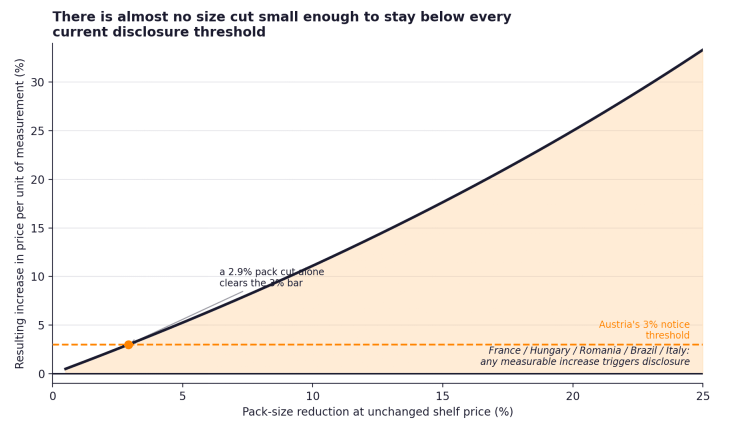
The practical implication is blunt: there is almost no pack-size cut small enough to sit under every applicable threshold at once. A reduction of roughly 3% — the kind of adjustment that is easy to wave off as a rounding change in a production spec — already clears Austria's bar on its own. Below that, in France, Hungary, Romania, Brazil and (pending resolution) Italy, there is no floor at all: a 1% cut that nudges the unit price up by just over 1% still triggers the disclosure duty in every one of those markets. The idea of engineering a resize that stays technically below the radar does not survive contact with how these thresholds are actually built.
That has a direct consequence for how RASPER-style price-pack modelling should treat resize decisions in regulated markets: the question is no longer whether a given cut avoids disclosure — in practice it almost never does — but whether the disclosure, when it happens, lands on a shelf that has already explained the change, or on one where the state-mandated sticker is the first the shopper has heard of it.
Obligor and duration: the two variables that actually change execution
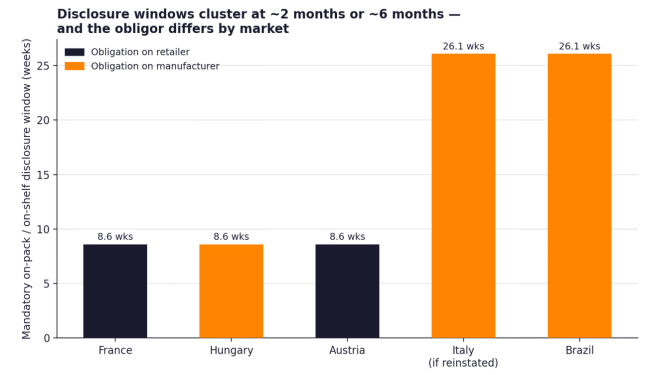
Two structural choices separate these regimes in ways that matter operationally: who has to make the disclosure, and for how long. Where the manufacturer carries the duty (Italy, Brazil, and half of Hungary's split obligation), the notice has to be built into the pack artwork itself, which means it is locked in at the print run and cannot be adjusted market-by-market after the fact. Where the retailer carries it (France, Austria, and the other half of Hungary's regime), the notice is a point-of-sale execution problem — solvable with signage and shelf-edge labels — but it puts the operational burden, and the fine exposure, on a distributor who may be selling a manufacturer's decision they had no part in making.
| Market | Instrument | Obligor | Trigger | Disclosure window |
|---|---|---|---|---|
| France | Order of 16 Apr 2024 | Retailer (>400 m²) | Any unit-price increase | 2 months |
| Hungary | Decree 1/2024 (I.9.) | Manufacturer + retailer | Any “significant” reduction | 2 months |
| Romania | ANPC Order 539/2024 | Seller | Any unit-price increase | At point of sale |
| Austria | Anti-Mogelpackungs-Gesetz | Retailer (>400 m² or 5+ stores) | Unit price up >3% | 60 days |
| Italy | Consumer Code art. 15-bis | Manufacturer | Any unit-price increase | 6 months |
| Brazil | 2024 labelling rule | Manufacturer | Any volume/weight cut | 6 months |
| UK | Price Marking Order (amended) | Retailer | N/A — broader unit pricing | Ongoing |
Table 1. Disclosure mechanics by market as of 9 July 2026. Sources listed at the end of this note.
Price-pack architecture as the strategic response
None of this argues for abandoning price-pack architecture as a margin-management tool — PPA remains one of the most effective levers a consumer goods company has for absorbing cost inflation without a blunt, category-wide list-price increase. What has changed is which version of PPA still works. Industry analyses of the current cycle draw a consistent line between incremental PPA — a straightforward pack shrink used reactively to hit a cost target — and transformational PPA, which builds a genuine ladder of pack formats and price points around real consumption occasions: a trial size, an everyday size, a bulk size, a portion-controlled size, each justified on its own terms rather than existing as a disguised version of the format it replaced.
The distinction matters directly under a disclosure regime, because incremental PPA is exactly the pattern these laws were written to catch: the same pack, the same price, quietly less inside. Transformational PPA sidesteps the disclosure problem almost entirely, not through loophole-seeking but because a genuinely new format at a new price point is not a same-pack-smaller-fill event in the first place — it is a new SKU, and a shopper choosing it is choosing a size, not discovering a shrink after the fact.
• Separate the two moves explicitly inside the RGM process. A cost-driven resize of an existing SKU should be flagged and modelled differently from a new-format launch, even when both originate from the same input-cost pressure, because only the first carries disclosure exposure.
• Model the unit-price delta before the pack spec is finalised, not after. Given how little room the current thresholds leave (Chart 2), the unit-price consequence of a resize should be a standard output of the pack-change approval workflow, checked against the applicable regime for every market the SKU ships to — not a compliance check bolted on once production is committed.
• Default to disclosing ahead of the mandate in markets without one yet. Belgium, Spain and Portugal have draft bills in circulation; a resize executed quietly today in one of those markets is a resize a consumer-tracker site or journalist can resurface the moment the law catches up, with none of the context a proactive on-pack note would have provided.
• Treat the manufacturer/retailer obligor split as a supply-chain coordination problem, not just a legal one. In split-obligation markets like Hungary, and in retailer-obligor markets like France and Austria, the retailer needs advance notice of any resize with enough lead time to prepare shelf signage — a scramble at the point of sale is itself a reputational event, independent of the underlying pack change.
Where the strategy still fails
Two recent cases show the limits of even a compliant, well-executed resize. In May 2026, a German court ruled against Mondelēz over Milka chocolate bars that had gone from 100 grams to 90 grams while keeping largely the same packaging; the court found that accurate weight labelling on its own was not enough to prevent consumer confusion, because the overall pack presentation still implied continuity with the earlier, larger bar. Germany has no shrinkflation-specific statute, so the ruling rests on general unfair-commercial-practice principles — a reminder that meeting a disclosure regime's minimum wording requirement does not automatically satisfy a court's broader test of whether a reasonable consumer was misled by the pack as a whole.
Italy's experience illustrates the opposite failure mode: a design that over-corrected. By putting the duty on manufacturers and requiring an on-pack statement in the product's own main visual field for six months, the rule created exactly the kind of undifferentiated, category-wide stigma a well-run PPA program is meant to avoid — a sticker on every resized product regardless of whether the resize was a defensible reformulation, a genuine new format, or a straightforward cost pass-through. The European Commission's proportionality objection and the resulting two-year delay suggest that even regulators can conclude a disclosure mechanism has gone further than the underlying transparency goal requires.
The throughline across both cases is the same: neither the letter of a disclosure law nor its complete absence settles the reputational question on its own. A pack change that a shopper discovers via a mandated sticker, a court judgment, or a consumer-tracker feed reads as concealment regardless of which of those three triggered the discovery. A pack change the shopper was already told about — on-pack, ahead of any mandate, framed as a deliberate format choice — reads as ordinary retail variety, in every jurisdiction this note covers.
The takeaway
Shrinkflation disclosure law is not converging toward a single global standard the way, for instance, unit-pricing requirements largely have. It is fragmenting into at least three distinct designs — retailer-side notices, manufacturer-side labels, and unit-price-transparency expansions — each with its own trigger, obligor and duration, and at least one of them (Italy's) still contested at the EU level nearly a year and a half after it was legislated. For a multinational running price-pack architecture across these markets, the operating assumption has to be that almost any resize with a real cost-saving impact will clear the disclosure bar somewhere in the portfolio's footprint. The strategic question worth spending analytical effort on is not whether a cut is small enough to avoid triggering a notice — the math above says it usually is not — but whether the architecture around that cut gives the shopper a reason to see it as intentional and well-communicated before a regulator, a court, or a consumer-tracker site tells them otherwise.
Methodology note: the regulatory timeline, thresholds and disclosure mechanics in this note are drawn directly from the underlying legal instruments (Journal Officiel, Legifrance, Hungarian and Romanian official decrees) and from law-firm and industry regulatory trackers current as of 9 July 2026, listed below. The unit-price relationship in Chart 2 is a direct, deterministic calculation (price held constant, unit price equal to price divided by quantity) rather than a statistical estimate, and is not dependent on any modelling assumption beyond that definition. Given how quickly this particular area is moving — Italy's date alone has shifted twice since the underlying law was passed — dates and thresholds should be re-verified against a primary source before this note is used for a specific compliance decision.
- France — Arrêté du 16 avril 2024 (Journal Officiel, Legifrance, official text) — https://www.legifrance.gouv.fr/jorf/id/JORFTEXT000049502248
- France — DGCCRF ministerial press release announcing the order — https://presse.economie.gouv.fr/reduflation-publication-de-larrete-ministeriel-reglementant-linformation-des-consommateurs-sur-laugmentation-des-prix-des-produits-dont-la-quantite-a-diminue/
- Hungary — Government Decree 1/2024 (I.9.) summary, Lakatos Köves and Partners — https://www.lakatoskoves.hu/news/new-shrinkflation-regulation-to-enter-into-force-on-1-february-2024
- Romania — ANPC Order 539/2024 summary, DLA Piper International Shrinkflation Guide — https://www.dlapiper.com/en/insights/topics/international-shrinkflation-guide
- Italy — Consumer Code art. 15-bis and EU infringement proceedings, Il Sole 24 Ore — https://en.ilsole24ore.com/art/reduced-packaging-but-same-price-label-obligation-postponed-2026-heres-what-it-is-and-why-its-getting-longer-AHIDsRgC
- Italy — legal analysis of art. 15-bis, Osborne Clarke — https://www.osborneclarke.com/insights/shrinkflation-new-rules-and-implications-italy
- Austria — Anti-Mogelpackungs-Gesetz overview, Leatherhead / Sagentia (31 Mar 2026) — https://sagentia.com/blog/navigating-shrinkflation-labelling-rules-across-europe/
- Austria — DLA Piper International Shrinkflation Guide (jurisdiction Q&A) — https://www.dlapiper.com/en/insights/topics/international-shrinkflation-guide
- UK — Price Marking (Amendment) Order 2025, legislation.gov.uk — https://www.legislation.gov.uk/uksi/2025/592/body/made
- UK — Price Marking Order reform overview, RPC — https://www.rpclegal.com/snapshots/consumer/autumn-2025/uk-pricing-facing-major-overhaul-following-amendments-to-the-price-marking-order-2004/
- Australia — ACCC Supermarket Inquiry Report (21 Mar 2025) summary, DLA Piper — https://www.dlapiper.com/en/insights/topics/international-shrinkflation-guide
- Germany — Mondelēz / Milka ruling, ICERTIAS commentary (May 2026) — https://www.icertias.com/journal/shrinkskimpflation-the-new-risk-to-growth
- Price-pack architecture strategy framework, Consumer Goods Technology — https://consumergoods.com/price-pack-architecture-strategic-growth-lever-fmcg-resilience-and-relevance
- EU proportionality objection to Italy's rule, CMS Law-Now (25 Sep 2025) — https://cms-lawnow.com/en/ealerts/2025/09/shrinkflation-are-brands-and-supermarkets-required-to-inform-consumers-if-a-product-has-been-reduced-in-size-or-quantity-but-the-packaging-looks
- The World Cup Will Break Your Pricing. Are You Ready?
- The Third-Party Delivery Margin Trap
- The Always-On Shelf: How Real-Time Competitive Data Is Rewriting Retail Pricing
- Why Most Grocers Leave 200–300 bps on Perishables—and What the Digital Product Passport Will Force Them to Fix
- The Always-On Shelf: How Real-Time Competitive Data Is Rewriting Retail Pricing
- The Third-Party Delivery Margin Trap
RapidPricer helps automate pricing and promotions for retailers. The company has capabilities in retail pricing, artificial intelligence, and deep learning to compute merchandising actions for real-time execution in a retail environment.