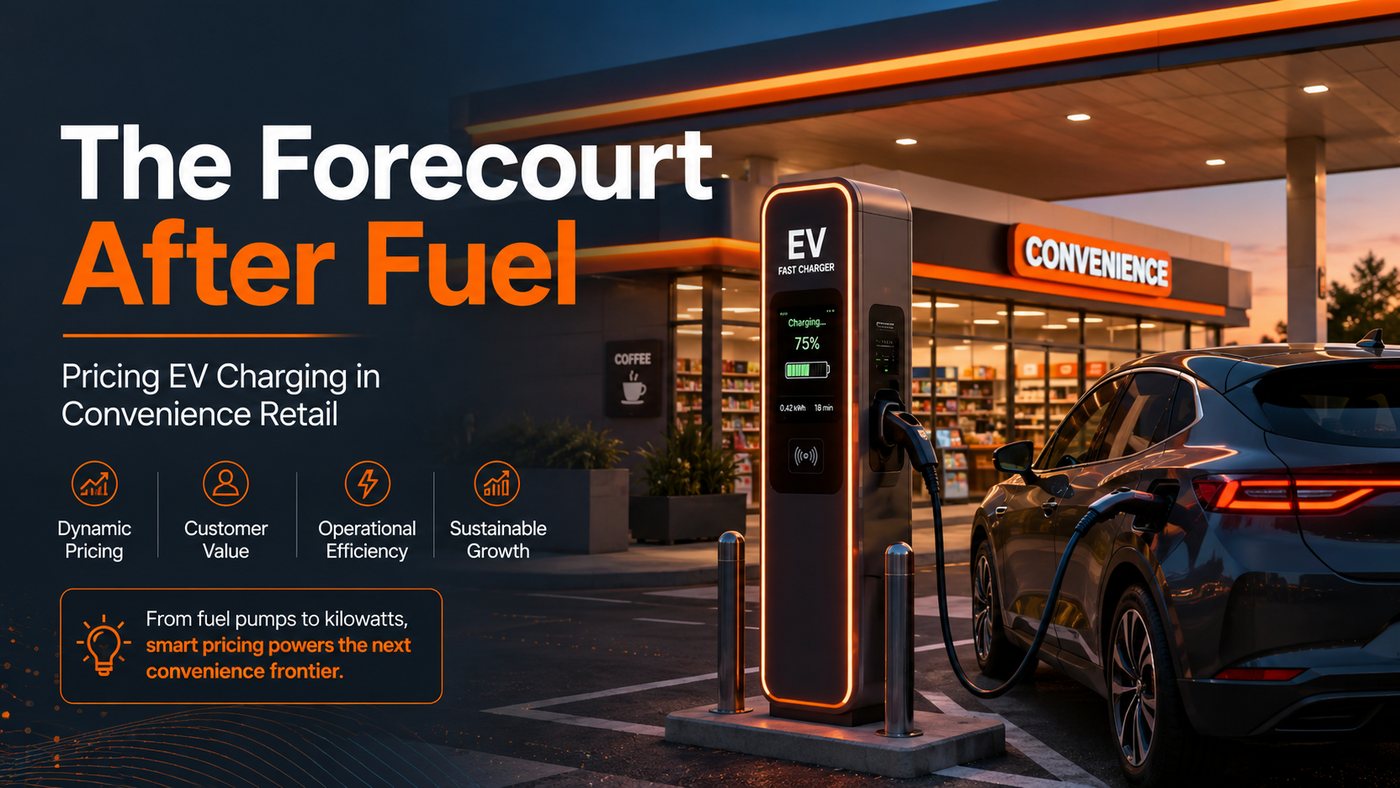
kWh tariffs · dwell-time economics · charge-and-shop bundles — a successor to our gas-station pricing research
Fuel margins are eroding faster than most convenience retailers modeled for. In the U.S., fuel contributed 65% of retailer revenue in 2025 but only 39% of profit — and KPMG expects non-fuel categories to generate up to 80% of forecourt profit by the mid-2030s. EV charging is the new front door to that non-fuel margin. But unlike gasoline, where the pump price is close to the whole story, an EV charging price sits on top of a utility tariff stack, a dwell-time-driven basket opportunity, and a bundling decision retailers are only beginning to price deliberately. This note breaks down all three, with worked numbers.
1. The kWh Tariff Stack
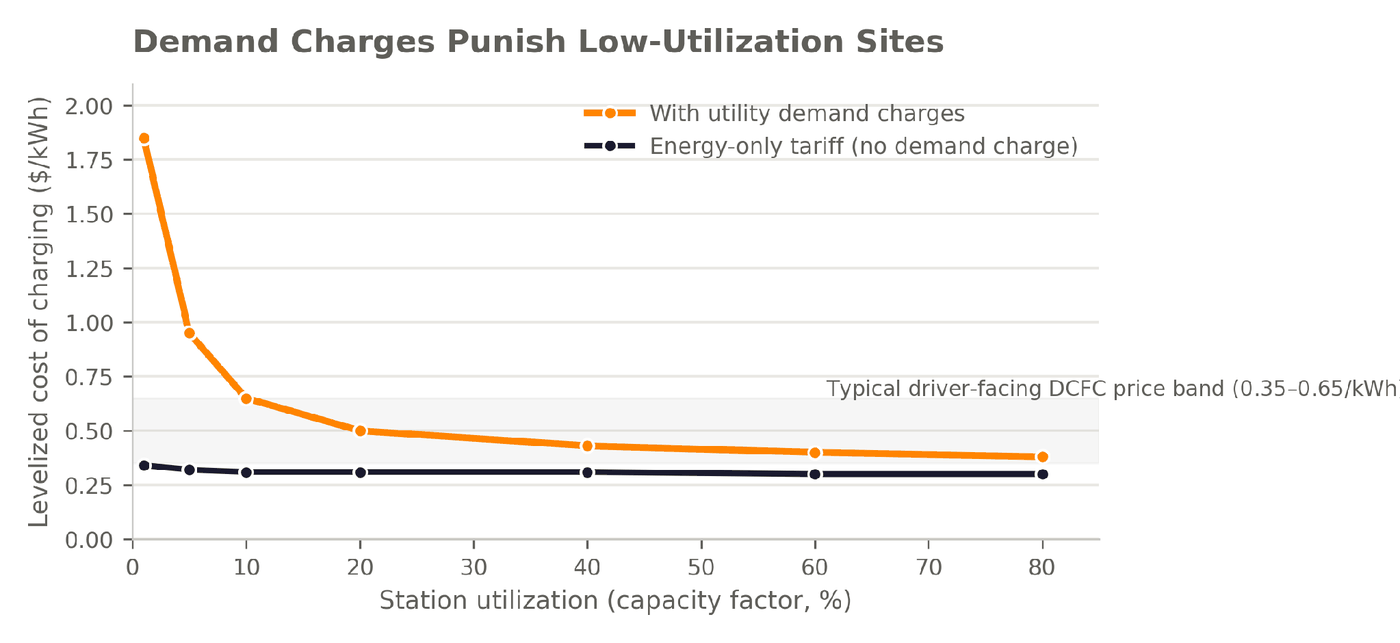
What a driver pays per kWh and what it costs the site to deliver that kWh are two different curves — and the gap is almost entirely explained by utility demand charges. Demand charges bill on a site's peak draw (kW) regardless of how much energy (kWh) is actually sold, so a DC fast charger idling at low utilization spreads a large fixed charge across very few paid sessions.
Published benchmarking puts U.S. non-member DC fast charging at roughly $0.51/kWh on average (Q2 2025), with a realistic planning band of $0.35–$0.65/kWh depending on state and network. Underneath that price, stations exposed to demand charges run a levelized cost of charging (LCOC) about 39% higher than stations on energy-only tariffs — and at the low-utilization end of the curve, demand-charge-exposed sites can see effective costs several multiples higher than the median. Demand charges alone have been measured at ~74% of a typical low-use commercial electric bill.
Europe's tariff stack is structured differently but the utilization sensitivity is similar. Fast-charging medians run from about €0.38/kWh in the cheapest markets (Finland, Bulgaria) up past €0.60–€0.70/kWh in higher-cost corridors, against an EU home electricity average near €0.29/kWh. AFIR's ad hoc payment mandate and ChargeUp Europe's push for modernized network tariffs are both, at core, arguments about who absorbs utilization risk — the same variable driving the U.S. curve above.
2. Dwell-Time Economics
A gasoline fill-up holds a customer for about five minutes. An EV charging session holds them for 15–35 minutes — and that difference is the actual commercial opportunity, not the electricity margin itself. McKinsey's analysis found EV drivers 45% more likely to enter the store than a fuel-only customer, spending 25% more on food once inside. Site-level data reinforces the pattern at the network level too: DC fast charging stations sited near a grocery anchor average roughly five times the session volume of the dataset median, because dwell time and footfall compound.
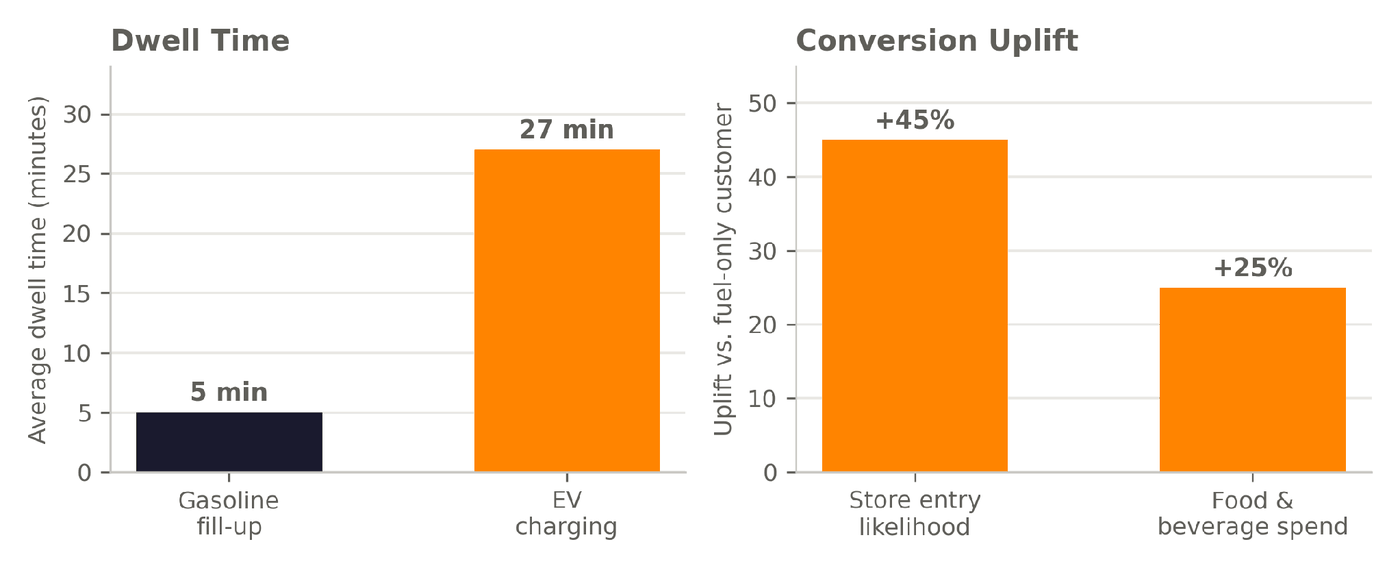
Retail-adjacent EV charging studies put incremental basket lift at roughly $1–$4 per charging visit — modest per session, but compounding across a site that may run dozens of sessions a day. The pricing implication: a kWh price set purely to match the posted rate at the DCFC down the road ignores the larger, higher-margin lever sitting inside the store.
3. Charge-and-Shop Bundle Economics
The commercial case for bundling is straightforward: give up some electricity margin to pull more sessions into a basket-qualifying purchase, and fund the discount from non-fuel margin rather than the energy line. The worked example below assumes a 35 kWh session (roughly a 20–30 minute DC fast-charge top-up) and applies the entry-rate and spend uplifts from Section 2 to a bundle that discounts $0.05/kWh (about 11%) when the driver taps a loyalty offer or crosses a small in-store spend threshold.
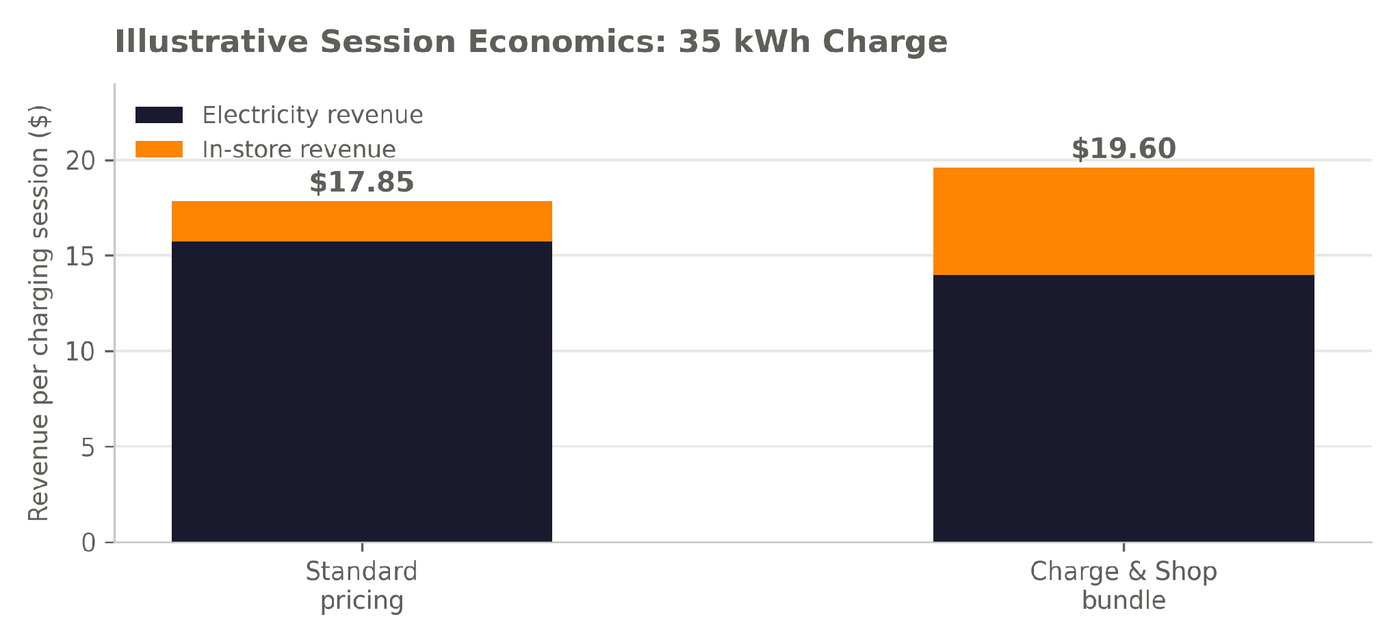
Even after giving back $1.75 in electricity margin per session, modeled total revenue per session rises from $17.85 to $19.60 — roughly a 10% lift — because the entry-rate and basket-size gains land on non-fuel categories that typically carry far thicker margins than electricity resale. This is directionally consistent with what operators are already doing: Walmart's W+ members get 10% off posted EV pricing at pilot sites, and convenience chains such as ON the RUN are folding charging into existing loyalty rails rather than pricing it as a standalone product.
4. A Pricing Playbook For The Forecourt
01 Price to utilization, not just to the competitor's post. A site running at 5% capacity factor has a fundamentally different cost floor than one at 40% — static competitor-matching ignores that gap entirely.
02 Treat the kWh margin as a funded lever, not a standalone P&L. Bundle discounts should be sized against non-fuel margin capture, per Figure 3, not against the electricity cost alone.
03 Segment tariffs by dwell format. A DCFC quick-stop site and an L2 grocery-anchor site face different guardrails and should carry different bundle designs, not one flat rate.
04 Instrument competitor and utility tariff moves together. Demand-charge exposure and rival kWh pricing both move the breakeven point — track them on the same cadence.
05 Test threshold-triggered offers before blanket cuts. A $0.05/kWh discount tied to a small in-store spend outperforms an across-the-board price cut on both margin and basket size.
Fuel pricing spent two decades converging on real-time, competitor-aware automation. EV charging pricing is at the stage fuel pricing was a decade ago: posted rates, thin tariff visibility, and bundles built on instinct rather than measured uplift. The forecourts that price the full stack — tariff, dwell time, and bundle — as one system, rather than three separate decisions, will be the ones that make EV charging a genuine profit center rather than a break-even amenity.
ChargeUp Europe, Pricing Explained & industry reporting (2026); NACS/C-Store Dive, EV charging & dwell-time coverage (2025–2026); Transportation Energy Institute, 2026 State of Retail-First EV Charging (with Electric Era & Paren); Driivz, “EV Charging: The $151bn Opportunity for Fuel Retailers” and related analysis (2026); ScienceDirect, “Economics of electric vehicle corridor fast charging in the United States” (2025); NASEO, “Demand Charges & Electric Vehicle Fast-Charging”; Paren, State of the US EV Fast-Charging Industry Report; Eleport, EV Charging Cost Analysis – Europe (2025–2026); EV Connect, EVoucher loyalty program coverage (2026).
RapidPricer helps automate pricing and promotions for retailers. The company has capabilities in retail pricing, artificial intelligence, and deep learning to compute merchandising actions for real-time execution in a retail environment.