Regulation (EU) 2025/40 replaces three decades of packaging law across all 27 EU member states. Starting 12 August 2026, the rules change permanently — and the cost lands unevenly across the supply chain, depending on packaging choices that most brands have already made.
| APPLICATION DATE: 12 AUGUST 2026 Regulation (EU) 2025/40 applies from 12 August 2026. Non-compliant packaging cannot be placed on the EU market from this date. There is no grace period, no small-business carve-out, and no national transposition delay. |
|---|
The Mechanism Nobody Is Pricing For
The grocery industry has spent four years navigating one inflationary wave after another — commodity shocks, energy spikes, shipping crises, tariff battles. Each time, the cost debate plays out the same way: brands push for list price increases, retailers resist, and consumers eventually absorb some of the pain.
PPWR is a fundamentally different animal. It is not a market event. It is a scheduled, permanent, legally-mandated cost uplift — with no commodity cycle to reverse it. Because PPWR is a Regulation, not a Directive, the rules are identical from Lisbon to Helsinki and enforceable from day one, with no national transposition delay.
For pricing professionals, the critical question is not whether costs will rise — they will — but who absorbs them, in what sequence, and what the resulting shelf-price signal looks like. That answer varies dramatically by packaging format, market, and supply chain position.
| "A PET/PE laminate pays 2–3× the EPR fee of a mono-material equivalent. That is not a sustainability charge. It is a structural margin problem baked into every SKU that uses it." — RapidPricer Analysis, 2026 |
|---|
The Three Cost Channels
PPWR's financial impact arrives through three distinct mechanisms, each with a different timing and incidence profile. Understanding them separately is essential for pricing strategy.
Channel 1 — Extended Producer Responsibility (EPR) Fees
EPR is not new. France, Germany, Spain, Italy and others have operated national Producer Responsibility Organisation (PRO) systems for years. What PPWR does is harmonise the floor of those systems and introduce mandatory eco-modulation — fees are now required by EU law to vary based on recyclability performance, not just weight and material category.
The eco-modulation coefficient is the key lever. Under the old directive, many national PROs charged a flat rate regardless of recyclability. Under PPWR, the coefficient can range from below 0.5× for best-in-class recyclable formats to above 3× for composite or non-recyclable ones. The fee differential between the same weight of mono-material PET versus a PET/PE laminate can therefore be three to four times the base rate — not a marginal penalty but a multiplier that creates a structural cost problem.
To illustrate the scale of national variation: aluminium packaging EPR fees alone range from €48 per tonne in Belgium to €1,090 per tonne in Sweden — a 22.7× spread for the same material. Country mix matters enormously for any multi-market brand.
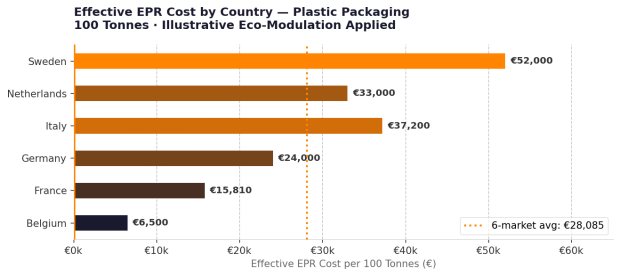
Brands without adequate documentation will be assigned to the highest EPR fee bracket by default — a 25–40% penalty on top of an already elevated rate. ERM estimates this default categorisation could lead to companies paying 70–90% more than necessary.
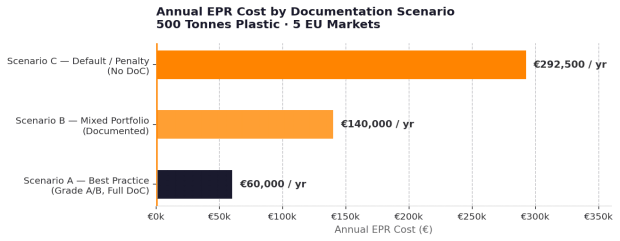
The spread between a best-practice documented brand and a non-documented one — on exactly the same physical volume of packaging — illustrates a critical insight: this is not a compliance cost. It is a pricing inefficiency driven entirely by data quality.
Channel 2 — Reuse System Infrastructure Costs
From 12 August 2026, operators who already place reusable packaging on the market must have active reuse systems in place: collection, reconditioning, and redistribution of reusable units. This is not a mandate to switch from single-use — but it is a mandate to operationalise whatever reuse claims a brand already makes on its packaging.
More significantly for FMCG, PPWR imposes reuse targets for beverage packaging by 2030, and from February 2027, HORECA operators must allow consumers to bring their own containers and offer refill options for beverages. The capital required to build these systems — refill stations, deposit return scheme participation, reverse logistics — cannot be absorbed in a quarter. Brands that begin investing in 2026 will find the unit economics dramatically more favourable than those that scramble in 2029.
Channel 3 — Conformity Documentation and Compliance Overhead
Every packaging format placed on the EU market after 12 August 2026 must be accompanied by a Declaration of Conformity (DoC). This document must evidence PFAS compliance, recyclability grade, material composition, and EPR registration status.
Brands that cannot produce granular packaging data at SKU level will be assigned to the highest EPR fee bracket by default. The penalty for administrative incompleteness is therefore larger than the penalty for bad packaging design. The conformity documentation chain runs: packaging supplier → brand → EPR registration → national PRO → fee calculation. Every link where data is absent is a step toward the penalty bracket.
Where Costs Absorb Versus Pass Through
European grocery retailers will resist manufacturer price increase requests below approximately 0.8% of shelf-price movement. Above approximately 3.5%, they negotiate hard on mix or seek private label substitution. The pass-or-absorb boundary sits almost exactly at the PPWR recyclability grade boundary between C and D.
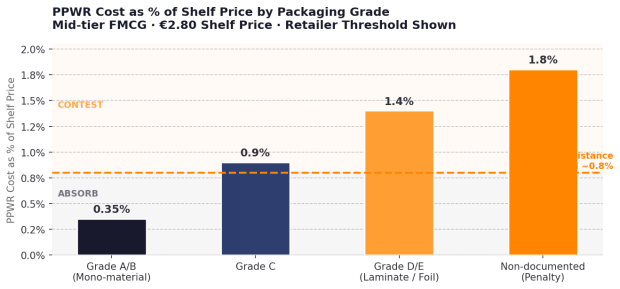
- Grade A/B packaging: PPWR cost stays below 0.5% of shelf price — absorbed without consumer-visible change.
- Grade D/E packaging: PPWR cost exceeds 1.0% of shelf price — contested pass-through territory.
- Non-documented: PPWR cost reaches 1.4–2.1% of shelf price — structural repricing is unavoidable.
The counterintuitive finding concerns premium products. A high-end product using non-recyclable multi-layer packaging faces a significant PPWR cost in absolute terms, but as a fraction of shelf price the impact is modest — the margin cushion at premium price points is large enough to absorb. The problem is concentrated almost entirely in value and mid-tier FMCG using complex flexible packaging — precisely where margins are thinnest and retailer leverage is highest.
| "Budget and mid-tier FMCG brands using complex flexible packaging are caught in a vise: packaging grades they can't easily change, margins that can't absorb the cost, and retailers who won't pass it through." — RapidPricer Analysis, 2026 |
|---|
The Cost of Delay: Why Reformulating Now Pays Off
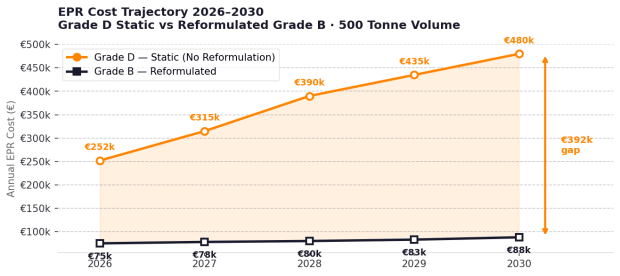
Using the UK's PackUK system as a lead indicator — the most mature eco-modulated EPR system in the English-language regulatory space — the fee gap between recyclable and non-recyclable formats widens over time. What starts as a modest multiplier in 2026 becomes a far heavier burden by 2028. EU eco-modulation is following the same trajectory.
A brand holding non-recyclable packaging today is not paying a one-time transition cost. It is locking in an escalating, compounding liability — while the cost of a one-time redesign is typically recovered in under 18 months.
Four Competitive Positions Created by PPWR
For pricing teams and commercial strategists, the PPWR cost architecture creates four identifiable competitive positions. The position a brand occupies is largely determined by a decision made today — not in 2029.
| Position | Packaging Grade | Documentation | Pricing Implication |
|---|---|---|---|
| Leader | A–B, mono-material | Full DoC | Significant cost advantage over non-compliant peers. Can undercut on price or protect margin. Regulatory tailwind accelerates the annual advantage. |
| Adapter | C–D, transitioning | Full DoC | Documented but not yet reformulated. Cost is real but not catastrophic. Transition investment is the priority. |
| Laggard | D–E, static | Partial | Escalating cost, limited pass-through room. Either reformulates under time pressure (costly) or reprices into a competitive disadvantage. |
| Non-compliant | Unknown/E | None/penalty | Structural margin destruction. Potential market-access ban after enforcement begins. Pricing strategy is irrelevant — operational survival is the issue. |
PPWR does not create a uniform industry cost increase that all brands can pass through simultaneously. It creates a divergence. A Leader-position brand and a Non-compliant brand in the same category at the same shelf price point have dramatically different margin profiles. Over a 3–5 year horizon, that structural cost divergence reshapes category dynamics in ways that are very difficult to reverse.
The Compliance Timeline: What Activates When
| Date | What Activates |
|---|---|
| 12 Aug 2026 | Core PPWR provisions apply. PFAS ban in food-contact packaging. DoC requirement active. EPR eco-modulation harmonised at the EU level. Non-compliant packaging cannot be placed on the EU market. |
| Feb 2027 | HORECA refill obligations. Final distributors in Hotel, Restaurant, and Catering must allow consumers to bring their own containers and offer refill options for beverages. |
| Aug 2027 | Digital labelling phase begins. Packaging must carry QR codes linking to structured environmental information: material composition, recyclability, and reuse details. |
| Aug 2028 | Standardised sorting pictograms mandatory across all packaging. |
| Feb 2029 | QR codes on reusable packaging with specific environmental and operational data. |
| Jan 2030 | Major recyclability and recycled-content thresholds. Minimum 70% of packaging waste must be recycled. Mandatory post-consumer recycled content targets activate for plastics. |
| 2029–2030 | EU-level producer registry replaces national databases, streamlining multi-market compliance. |
The Shrinkflation Risk
One tempting response to PPWR cost pressure — particularly for brands already under scrutiny for shrinkflation — is to reduce packaging size as a proxy for packaging redesign. The PPWR explicitly anticipates and constrains this. Volume efficiency rules penalise excessive empty space: a 50% empty-space cap for retail packaging and 40% for e-commerce, effective 2030.
Brands that downsize contents without redesigning the packaging structure could find themselves accumulating both shrinkflation regulatory exposure and a failing packaging volume efficiency score simultaneously. This is not a path forward — it is a path to a more complex and more public compliance problem.
Practical Implications for Pricing Teams
1 — Map your packaging grade at SKU level before repricing
EPR fees are assessed at SKU level, not brand level. A single SKU using a high-penalty laminate in a portfolio otherwise using Grade B materials can distort your total liability significantly. Pricing teams should request packaging grade data from procurement and map it against the EPR rate schedule for each market where the SKU is sold.
2 — Model two price scenarios, not one
Given the uncertainty in eco-modulation coefficient trajectories — several national PROs have yet to finalise their PPWR-aligned fee schedules — pricing teams should model both a conservative scenario and a stress scenario over a three-year horizon. The stress scenario, based on the observed UK fee trajectory, should be treated as the planning base for any capital commitment.
3 — Use the compliance investment as a pricing narrative
Brands that have genuinely invested in PPWR-compliant reformulation can use that investment as a value-based pricing signal with consumers who are increasingly responsive to verified sustainability credentials. With a DoC and a PPWR Annex II recyclability grade, the claim is auditable. Without it, it is greenwash exposure.
4 — Build PPWR cost into trade terms negotiations starting now
The 60–90 day lag between wholesale cost increases and retail shelf price adjustment means that brands negotiating trade terms in Q3 2026 should already be pricing the post-August compliance cost into their proposed economics. Retailers who have been told PPWR will not affect prices will be less cooperative in September than retailers who had the conversation in June. Brands that complete retailer negotiations before 12 August buy themselves a full quarter's lead time.
Conclusion: A Structural Pricing Event, Not a Cost-of-Goods Line
The error most pricing teams are making with PPWR is treating it as a single-line cost increase to be modelled, negotiated, and passed through like an energy surcharge. It is something structurally different: a regulatory mechanism that creates a persistent and widening cost gap between brands based on packaging decisions that are mostly already made.
The inflection point that determines whether PPWR costs absorb or require repricing sits at the PPWR recyclability Grade C/D boundary. Below that line — roughly mono-material, documented, with a low eco-modulation coefficient — the per-unit cost is manageable and absorbed without consumer-visible change. Above that line, the cost is material, contested, and escalating annually as eco-modulation tightens.
For RapidPricer users, this creates a specific analytical need: the ability to flag SKUs using non-Grade-A/B packaging formats, priced in the band where pass-through is contested, and in markets with high eco-modulation intensity such as France, Italy, and Sweden. Those three filters identify the segment of the portfolio where PPWR creates a live pricing problem — not a future compliance date on a Gantt chart.
The clock is running. The cost is calculable. The only variable left is whether pricing teams engage before or after the invoice arrives.
| KEY FINDINGS Finding 1: The EPR fee differential between best-practice and default-penalty packaging on the same physical volume can exceed €230,000 per year for a mid-size FMCG brand — driven overwhelmingly by documentation quality, not packaging material cost. Finding 2: PPWR compliance cost crosses the retailer pass-through threshold precisely at the Grade C/D packaging boundary. This reflects the mathematical structure of EPR eco-modulation multipliers. Finding 3: The cost of delaying packaging redesign from 2026 to 2028 significantly exceeds a one-time redesign investment. The return-on-investment breakeven is approximately 18 months. Finding 4: The 60–90 day wholesale-to-retail price transmission lag implies Q4 2026 as the first window of PPWR-attributable margin compression for laggard brands. Brands completing retailer negotiations before August 12 avoid that compression entirely. |
|---|
Sources and References
1. European Commission, PPWR FAQ and Implementation Guidance, 30 March 2026. Regulation (EU) 2025/40, OJ L 22 January 2025.
2. Latham & Watkins / Global ELR, European Packaging and Packaging Waste Regulation: Summary of Provisions and New Guidance, April 2026.
3. Amcor, Packaging and Packaging Waste Regulation — Top 6 Things to Know, January 2026.
4. RegSurance, Reduce PPWR & EPR Fees: Eco-Modulation Guide, November 2025.
5. Grounded Packaging, UK EPR vs EU PPWR: A Practical Compliance Guide, April 2026.
6. Net Zero Compare, Extended Producer Responsibility for Packaging: Country-by-Country Comparison, 2025.
7. ERM (Environmental Resources Management), How PPWR Will Revolutionize Packaging in the EU and Beyond, 2025.
8. Simon-Kucher, EU PPWR Demands a Commercial Strategy Reset, November 2025.
9. Purdue University Center for Commercial Agriculture, The March 2026 Producer Price Index: Reading the Food Price Pipeline, April 2026.
10. Revenue Management Labs, Key Pricing Trends Shaping Consumer Goods in 2026, 2026.
11. Gleiss Lutz, The New EU Packaging Regulation: Key Requirements from August 2026, 2026.
Disclaimer: This article was produced by RapidPricer Research. The analysis is constructed from publicly available regulatory data, PRO fee schedules, and market analyses. It is illustrative of structural cost dynamics rather than audited financial projections. Actual EPR fees vary by national PRO, declaration period, and annual rate revisions. Brands should obtain country-specific regulatory advice before making compliance or pricing decisions. This content was generated in part with the assistance of artificial intelligence tools.
- The World Cup Will Break Your Pricing. Are You Ready?
- The Third-Party Delivery Margin Trap
- The Always-On Shelf: How Real-Time Competitive Data Is Rewriting Retail Pricing
- Why Most Grocers Leave 200–300 bps on Perishables—and What the Digital Product Passport Will Force Them to Fix
- The Always-On Shelf: How Real-Time Competitive Data Is Rewriting Retail Pricing
- The Third-Party Delivery Margin Trap
RapidPricer helps automate pricing and promotions for retailers. The company has capabilities in retail pricing, artificial intelligence, and deep learning to compute merchandising actions for real-time execution in a retail environment.