
In today’s hyper-competitive retail landscape, pricing is no longer just a tool—it’s a competitive moat. Retailers that shift from manual or rule-based pricing to automated, data-driven pricing gain speed, precision, and adaptability. The winners are those that can respond in real time to demand shifts, cost pressures, and competitive moves.
Why Automation Matters Now
● Margin uplift & profit gains: Retailers implementing AI-based pricing report 5-10 % increases in gross profit while also growing revenue and improving perceived value.Boston Consulting Group
● Incremental revenue upside: According to a joint MIT / BCG study, algorithmic pricing can boost revenue by 1-5 %, and extend customer lifetime value by ~20 %.Pricing Society
● Operational leverage: One retailer using ClearDemand’s platform transitioned from manual pricing to automated workflows, unlocking USD 6 million in gross profit over 2.5 years, improving margin across key categories by ~20 %, and eliminating ~8 hours/week of manual work.ClearDemand
● Competitive necessity: Traditional rule-based pricing falls short in volatile markets. AI-enabled systems that integrate demand, cost, competitor, and strategic constraints lead to more optimal outcomes across items and stores.Boston Consulting Group
These numbers underscore a reality: automation is no longer optional—it’s table stakes in pricing strategy.
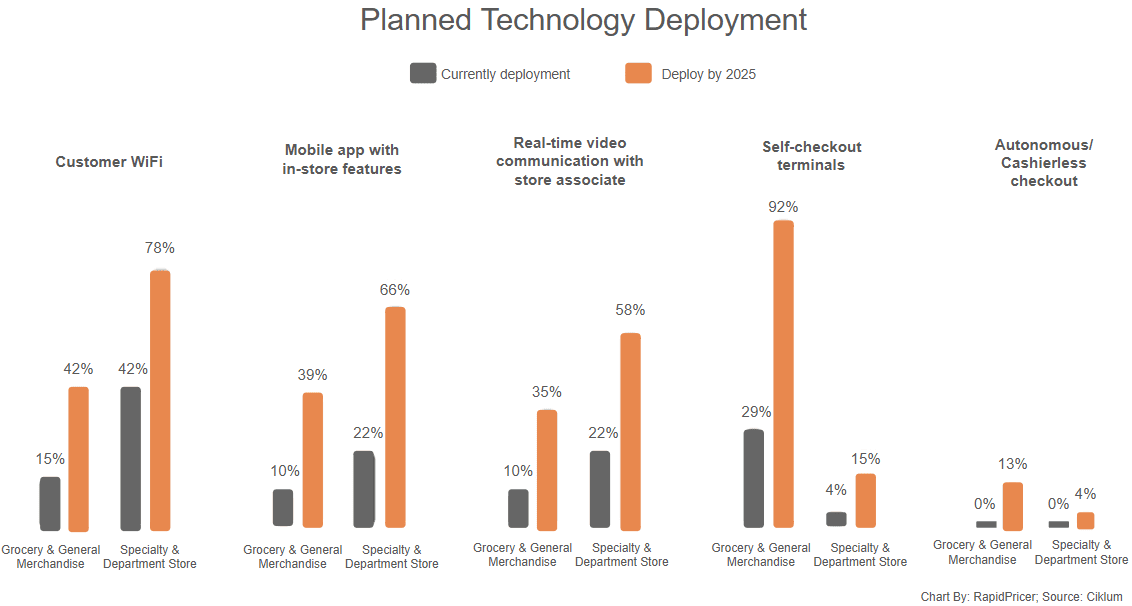
Figure 1: Planned Technology Deployment
How Leading Retailers are Using Automated Pricing
Below are real-world illustrations and lessons from retailers adopting automation.
| | | | | :-: | :-: | :-: | | **Retailer / Use Case** | **What They Did** | **Impact / Insight** | | **Walmart / Amazon** | Amazon reportedly updates its prices **~2.5 million times per day** using algorithmic pricing. | Massive scale, continuous repricing, and micro-optimization across SKUs. | | **Eastern European supermarket (Competera client)** | Used AI-driven pricing to manage cross-elasticity, promotional interplay, and margin protection. | Increased profits by **~7 %** in their core categories. | | **Grocery chain automating competitive/assortment intelligence** | Switched from manual price monitoring to automated intelligence. | Faster competitor reaction, better assortment alignment, and reduced data lag. | | **UK retailer via Tesseract** | Implemented dynamic pricing, integrating demand signals, competition, and inventory. | More precise price changes based on local dynamics. | | **E-commerce fashion retailer** | Deployed AI-driven dynamic pricing to track demand, trends, inventory, and competitive pricing. | 18 % revenue growth in the first 6 months; 15 % reduction in operational costs. |
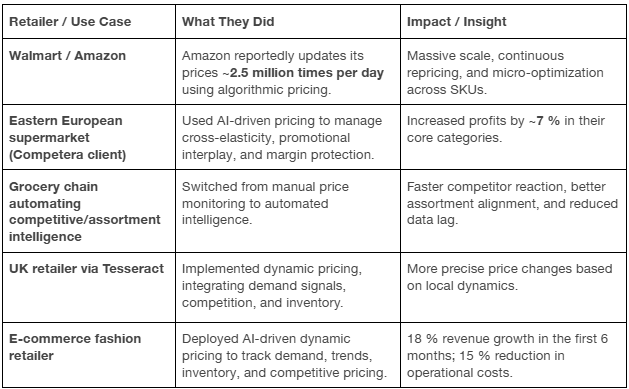
These examples show that whether grocery, general merchandise, or fashion, automation yields gains—not just theoretically, but in real business settings.
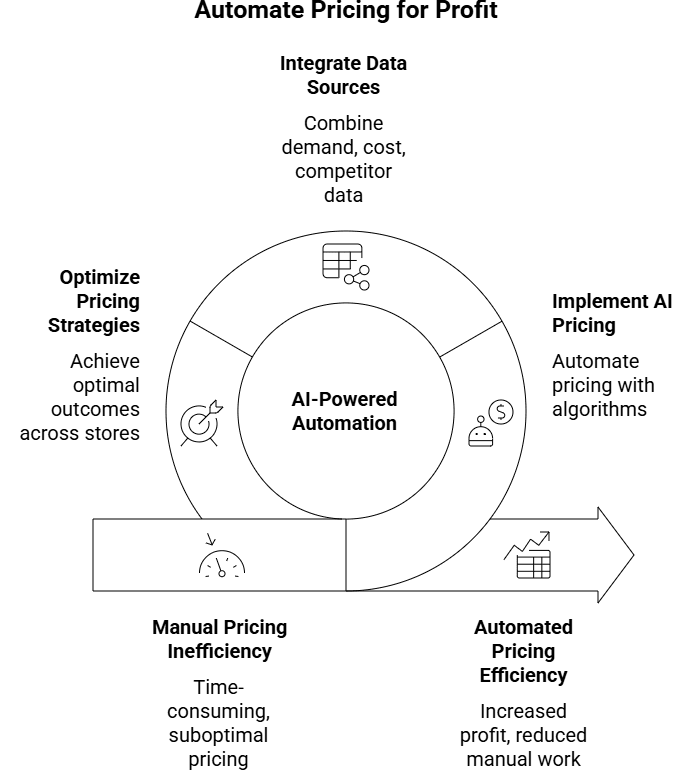
Figure 2: Automate Pricing for Profit
Key Pillars of Automated Pricing Capability
To shift pricing from reactive to strategic, you must build (or acquire) capabilities across these dimensions:
1. Data & Integration
○ Real-time cost inputs, competitor pricing feeds, inventory, and demand signals
○ Clean master data & product attributes
2. Elasticity, Demand & Forecast Models
○ SKU-level, store-level demand curves
○ Cross-elasticities and promotional lift modeling
3. Pricing Engine / Optimization Logic
○ Rule constraints (margins, thresholds, price ranges)
○ Multi-objective optimization (profit, volume, share)
○ Scenario simulation
4. Automation & Execution
○ Automated price uplifts/markdowns
○ Integration to price management systems or even electronic shelf labels
○ Anomaly detection & override alerts (e.g. Walmart’s anomaly detection in pricing)
5. Governance & Oversight
○ Pricing Center of Excellence or centralized pricing team
○ Monitoring, audits, overrides, escalations
○ Change management & communication
6. Continuous Learning & Feedback Loop
○ Measure real-world results vs. forecasts
○ Retrain models, retune elasticity, update rules
○ A/B test new strategies
BCG notes that success depends not just on technology, but on “a centralized pricing team, quick read-and-react processes, and a fully integrated data platform” to turn insights into action.Boston Consulting Group
Pitfalls & Risks to Guard Against
● Data quality & latency: Garbage in, garbage out. Poor master data or stale feeds lead to bad decisions.
● Customer perception & backlash: Price changes that are too frequent or opaque can erode trust.
● Overfitting & instability: Aggressive automation without smoothing or constraints may cause oscillations.
● Regulatory/fairness concerns: In some markets (or categories, like healthcare), differential or surge pricing requires special care.
● Lack of oversight/exception handling: Automated systems should always allow for human override and anomaly detection.
Steps to Implement Smart Pricing Automation in Your Business
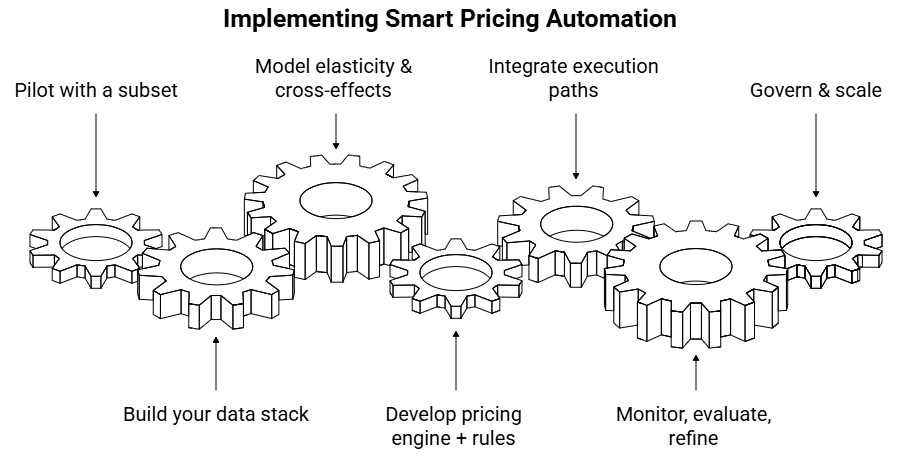
Figure 3: Implementing Smart Pricing Automation
1. Pilot with a subset: Choose 1–3 categories (e.g. OTC, fast-moving SKUs) to test automation.
2. Build your data stack: Ingest cost, competitor, demand, inventory. Clean data and unify.
3. Model elasticity & cross-effects: Use historical data, experiments, pricing lift tests.
4. Develop pricing engine + rules: Embed margin floors, price bands, strategic guardrails.
5. Integrate execution paths: Connect to your pricing systems or shelf display systems (if in-store).
6. Monitor, evaluate, refine: Compare forecast vs actual, adjust models, expand scope gradually.
7. Govern & scale: Set up central pricing governance, process flows, escalation paths.
Why “Smart Shift” Wins vs Price Wars or Manual Tactics
● Automation enables speed + precision — reacting faster than competitors to cost changes, stock shifts, and consumer trends.
● It lets you protect margins intelligently, by dynamically adjusting less elastic SKUs differently than more sensitive ones.
● The approach is scalable and consistent—instead of manual tweaks, you get unified, data-backed decisions across SKUs and stores.
● Over time, it becomes a durable competitive advantage—others can copy pricing logic, but the data, feedback loops, and tuning cannot be easily replicated.
*"*AI-Generated Content Disclaimer
*This content was generated in part with the assistance of artificial intelligence tools. While efforts have been made to review, edit, and ensure the accuracy, completeness, and reliability of the content, it may still contain errors or omissions. It should not be considered professional advice, and users should independently verify any information before making decisions based on it. The publisher/author assumes no responsibility or liability for any consequences resulting from reliance on this content."*
Read More On
● Real Business Impact of Automated Pricing: ROI, Accuracy, and Team Satisfaction
● From Firefighting to Forecasting: The Predictability Advantage of Pricing Automation
● Why Analysts Should Do Strategy, Not Spreadsheets
● How Automation Saves 100,000+ Hours Across Retail Stores Every Year
● 5 Signs Your Pricing Strategy Is Leaking Profits
● How Grocers Can Outprice E-Commerce: Winning the Basket Battle in 2025
● End of Manual Pricing: Intelligent Retail Demands Intelligent Pricing
● Evolution of Psychology Pricing in Retail with Artificial Intelligence
About RapidPricer
RapidPricer helps automate pricing and promotions for retailers. The company has capabilities in retail pricing, artificial intelligence, and deep learning to compute merchandising actions for real-time execution in a retail environment.
Contact info:
Website:
LinkedIn:
Email: info@rapidpricer.nl