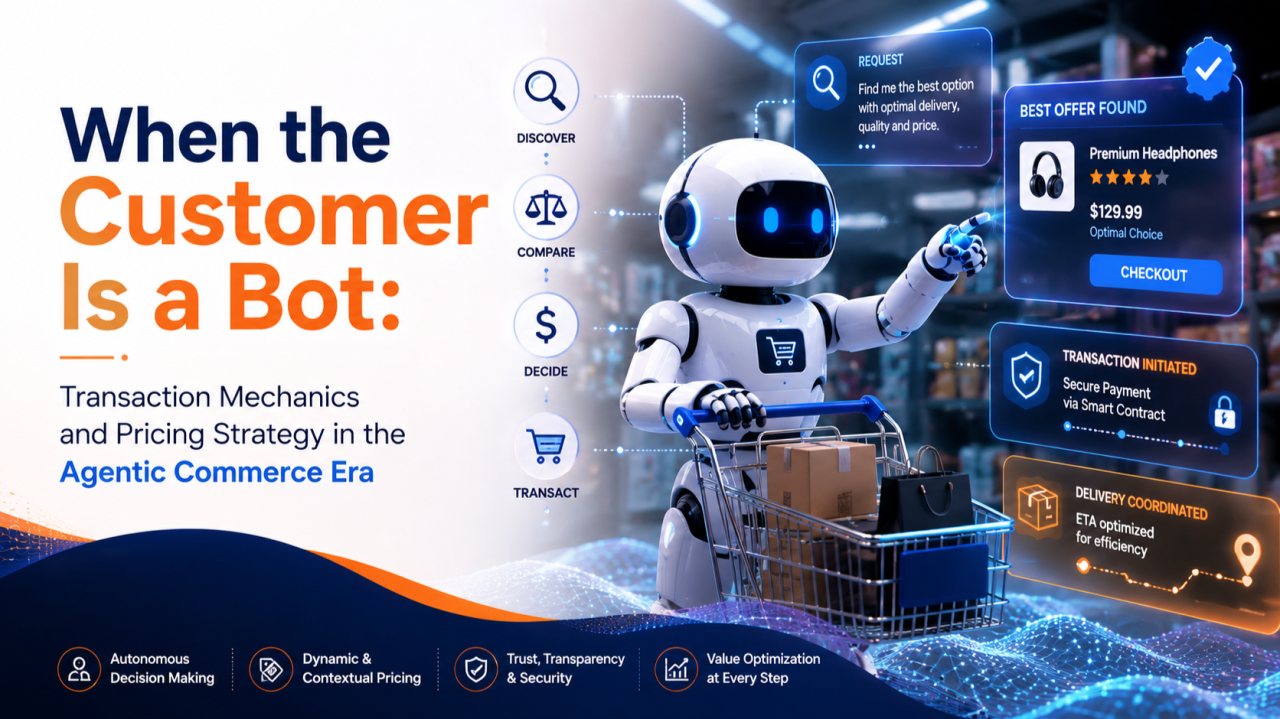
| Key Market Signals $5T global agentic commerce by 2030 (McKinsey) · 805% AI-driven traffic surge to U.S. retail, 2025 (Adobe) · 38% higher purchase completion from AI-referred visitors vs. search (Adobe, Black Friday 2025) · 4.4× higher conversion from AI recommendations vs. traditional search (McKinsey) · $12B incremental annualized sales from Amazon Rufus in 2025 |
|---|
Executive Summary
A structural discontinuity is underway in retail commerce. For the first time in e-commerce history, the entity deciding which product to buy, at what price, and from whom is not a human. It is an algorithm. AI shopping agents deployed by OpenAI, Google, Amazon, and Perplexity now mediate a measurable and rapidly growing share of all purchasing decisions.
This article delivers three things traditional coverage of agentic commerce does not: (1) a cross-platform analysis of the transaction mechanics and fee structures underlying each major agent ecosystem; (2) analytical interpretation of how pricing visibility correlates with conversion in machine-mediated commerce; and (3) a synthesis of what Bain, McKinsey, and Morgan Stanley projections imply for merchants who fail to make their pricing data machine-readable.
| Core Finding In agent-mediated commerce, price is no longer just a number — it is a structured signal. Merchants who treat pricing as human-readable text are invisible to agents that select winners algorithmically. The competitive question is no longer "Am I competitive?" It is: "Can the agent even read my price?" |
|---|
1. The Structural Shift: From Human Browsers to Machine Buyers
For two decades, e-commerce was optimised for one thing: persuading a human to click "Add to Cart." Conversion rate optimisation, visual merchandising, A/B-tested button colours — the entire discipline assumed a human decision-maker at the end of the funnel. That assumption is now wrong for a measurable and growing share of all transactions.
McKinsey's January 2026 Automation Curve framework defines six levels of shopping automation, from human-controlled (Level 0) to fully autonomous standing-objective agents (Level 4). Three commercially relevant layers exist today:
| Layer | Agent Behaviour | Pricing Implication | Live Example |
|---|---|---|---|
| Discovery | Reads product feeds, compares attributes, surfaces options to user | Price must be machine-readable in structured feed format | ChatGPT Shopping / Google AI Mode |
| Selection | Autonomously chooses winning product based on programmatic criteria (price, rating, availability, trust signals) | Price competitiveness is scored algorithmically — not perceived | Amazon Rufus "Help Me Decide" / Perplexity Buy with Pro |
| Execution | Completes checkout, handles payment, confirms delivery — no human in loop | Price must be real-time, API-consistent, and contractually stable for the agent's session | Amazon Rufus AutoBuy / Alexa+ threshold purchasing |
The shift to Layer 3 (execution) is already live at scale. Amazon's Alexa+ automatically purchases items when prices drop below a user-set threshold. Rufus delivered $12 billion in incremental annualised sales to Amazon in 2025, processing over 300 million customer interactions. McKinsey's Level 4 agents operate against standing goals — "Keep household essentials under $300 per month" — continuously monitoring, comparing, and optimising without human input.
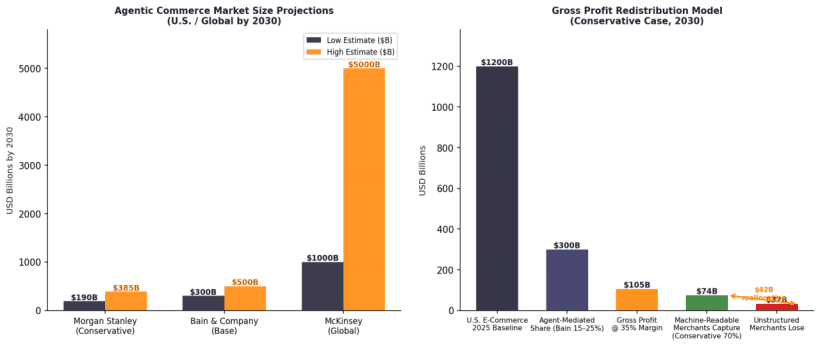
Figure 1 (left): Three independent forecasters' low and high estimates for agent-mediated commerce by 2030, U.S. and global. Figure 1 (right): Conservative gross profit redistribution model: at Bain's 15–25% agent share of U.S. e-commerce and a 35% industry gross margin, $63–105B in gross profit flows through agents by 2030. Machine-readable merchants capturing 70% of that flow gain a $42B structural advantage over unstructured competitors.
2. Platform Architecture: Transaction Mechanics Across the Major Agents
Each major platform has built a structurally different commerce architecture. Understanding these differences is prerequisite to any pricing strategy in the agentic era. The following is a cross-platform dissection of transaction mechanics — not the user-experience layer, but the infrastructure beneath it.
2.1 OpenAI/ChatGPT — Agentic Commerce Protocol (ACP)
OpenAI launched "Instant Checkout" in September 2025, co-developing the Agentic Commerce Protocol (ACP) with Stripe. The protocol requires a compressed product feed (gzip .jsonl.gz, .csv.gz, or .xml.gz) pushed to an OpenAI endpoint daily, a checkout API capable of receiving machine-initiated order requests, and a payment integration via Stripe or PayPal.
Fee structure: OpenAI charges merchants a 4% transaction fee on every completed Instant Checkout purchase, plus Stripe's standard ~2.9% + $0.30 per transaction. On a $100 order: $4.00 to OpenAI + $3.20 to Stripe = $7.20 total platform and processing cost. By March 2026, OpenAI had retreated from native checkout, pivoting to product discovery with purchases redirecting to merchant sites. The ACP protocol continues, but embedded checkout has been deprioritised in favour of "ChatGPT Apps."
2.2 Google — Universal Commerce Protocol (UCP)
Google announced the Universal Commerce Protocol at NRF January 2026, with Walmart, Wayfair, Chewy, and Etsy as early partners. Unlike ChatGPT and Perplexity — which rely on periodic data feed uploads — Google maintains a real-time structured product database via Merchant Center, evaluating pricing freshness at millisecond intervals. Stale or inconsistent pricing is a disqualification event, not merely a disadvantage.
2.3 Amazon — The Closed Ecosystem Strategy
Amazon's approach is categorically different. Amazon has blocked 47 AI crawlers and sued Perplexity to prevent external agents from accessing its marketplace — rational behaviour given its $68.6B advertising revenue in 2025, predicated on human shoppers scanning sponsored results. AI agents bypass sponsored placements entirely, selecting optimal products algorithmically.
Amazon's three-agent system: Rufus (in-ecosystem assistant, 300M+ customers, 60% higher conversion than non-AI sessions); Buy for Me (browser agent purchasing from external merchant sites); Alexa+ (voice-and-action agent for routine purchasing, free for Prime members).
2.4 Perplexity — The Neutral Advisor Model
Perplexity operates as an open-web, cross-merchant shopping agent charging merchants zero transaction fees. "Buy with Pro" (powered by PayPal Instant Buy) is designed to enhance its $20/month Pro subscription rather than extract transaction revenue — a structurally distinct position from all three competitors.
| Platform | Fee Model | Feed Requirement | Checkout Mechanism | Trust Architecture |
|---|---|---|---|---|
| OpenAI ACP | 4% transaction + payment processing | Daily gzip feed to OpenAI endpoint | In-app (retreating to redirect) | Open — third-party agent |
| Google UCP | Standard Google Shopping CPC | Merchant Centre real-time feed | Shopify Agentic Storefronts | Open — third-party agent |
| Amazon Rufus | $0 (ad revenue model) | Amazon listing data (no external feed) | Native Amazon checkout | Closed — highest consumer trust |
| Perplexity | $0 (Pro subscription model) | Merchant Program / open web | PayPal Instant Buy | Open — neutral advisor |
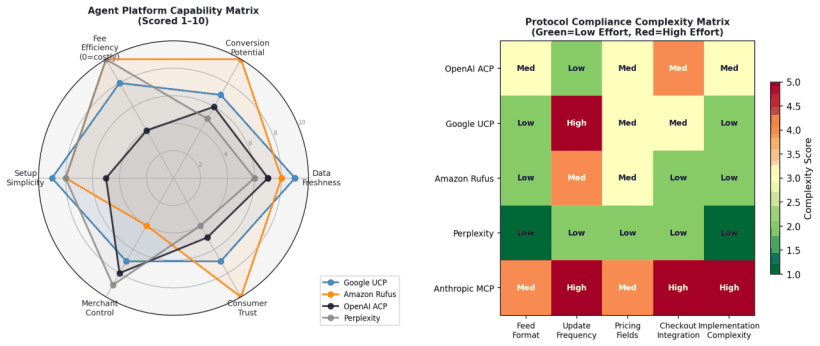
Figure 2 (left): Radar chart scoring each major agent platform across six dimensions (1–10). Amazon Rufus leads on consumer trust and conversion potential but scores lowest on merchant pricing control. Google UCP leads on data freshness and setup simplicity. Figure 2 (right): Compliance complexity heatmap by protocol and implementation dimension. Green = low effort; red = high effort. Anthropic MCP carries the highest compliance cost but enables the most dynamic agent-pricing interactions.
3. What the Data Actually Says: Conversion, Market Share, and Fee Economics
3.1 The Conversion Multiplier Analysis
Adobe Analytics reported that AI-referred visitors had a 38% higher purchase completion rate versus traditional search visitors during Black Friday 2025. McKinsey independently documented a 4.4× higher conversion for AI-generated product recommendations versus traditional search results.
These two multipliers operate at different funnel stages — the 4.4× premium applies at the recommendation stage (agent selects which product to surface); the 38% premium applies at the purchase-completion stage (visitor follows through). Merchants with machine-readable pricing capture both. Merchants with unstructured pricing may be excluded at the recommendation stage entirely, rendering the completion-rate advantage moot.
| Conversion Ceiling Analysis At a 2% baseline conversion rate from traditional search: Machine-readable conversion ceiling = Baseline × McKinsey multiplier × Adobe completion premium = 2% × 4.4 × 1.38 = 12.1% Even at 50% of theoretical maximum (accounting for competition and agent selectivity), this implies a 3× conversion improvement that is structurally inaccessible to merchants whose pricing cannot be read by agents. The 50% capture rate assumption produces a 6.05% expected conversion — still 3× the unstructured baseline. |
|---|
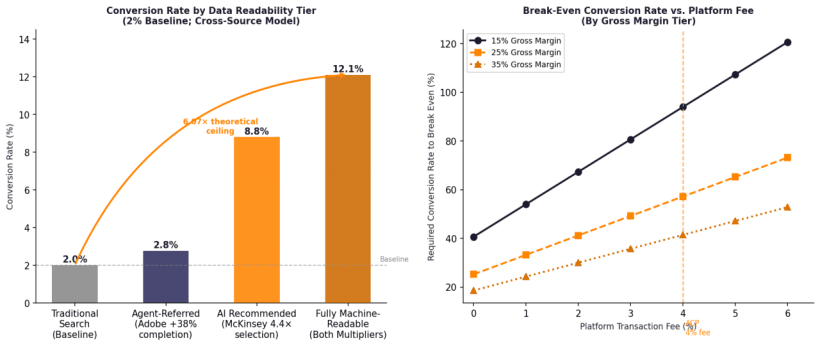
Figure 3 (left): Conversion rate decomposition across four merchant readiness tiers, starting from a 2% traditional search baseline. The 12.1% ceiling reflects the compounded Adobe (38%) and McKinsey (4.4×) multipliers. Figure 3 (right): Break-even conversion rate required to cover platform transaction fees at various gross margin tiers. At the ACP 4% fee level, merchants below 15% gross margin require conversion rates that exceed realistic agent-mediated performance — making agent-channel participation margin-destructive regardless of volume.
3.2 The Market-Share Redistribution Model
Three independent forecasters have sized the 2030 agentic commerce market differently: McKinsey at up to $5T globally; Bain at 15–25% of U.S. e-commerce ($300–500B); Morgan Stanley at 10–20% of U.S. online retail ($190–385B). The critical analytical point is not which projection is correct — it is the structural implication of even the conservative case.
Using Morgan Stanley's floor estimate of $190B in U.S. agentic commerce by 2030, and Bain's 15% bracket against a $1.2T 2025 U.S. e-commerce baseline: at an average industry gross margin of 35%, $63–105B in gross profit will be transacted through agents. If agents preferentially select products with machine-readable pricing — which the conversion data strongly implies — gross profit redistributes toward machine-readable merchants. At the conservative end, this is a $42B structural reallocation by 2030.
3.3 The Trust-Fee Paradox
Bain's 2026 consumer research found that consumers trust retailers' on-site AI agents 3× more than third-party agents like ChatGPT or Perplexity. Amazon's Rufus converts at 60% higher rates than non-AI sessions. Yet Amazon charges zero merchant fees while OpenAI charges 4%.
| Analytical Finding: The Inverted Trust-Fee Relationship The platform with the highest conversion advantage (Amazon Rufus, via trust and closed-ecosystem familiarity) charges merchants nothing in transaction fees. The platform with the highest transparency into pricing logic (Google UCP, open-protocol) charges standard CPC rates. The platform charging the explicit 4% transaction fee (OpenAI ACP) currently has the lowest consumer trust and the most volatile checkout architecture. This produces a counter-intuitive optimisation: the correct merchant response is not to prioritise fee minimisation, but to prioritise Amazon listing quality (highest ROI, zero incremental cost) while treating ACP integration as a channel test, not a primary revenue driver — until ChatGPT's checkout architecture stabilises. |
|---|
4. Machine-Readable Pricing: The Technical Specification Gap
The term "machine-readable pricing" is used frequently in agentic commerce discourse. It is rarely defined precisely. The following section provides the technical specification that pricing professionals and product teams need to close the gap.
An AI shopping agent selecting a product on a user's behalf requires seven pricing-related data points, all of which must be structured, current, and API-accessible:
| Data Point | Format Requirement | Failure Mode if Absent |
|---|---|---|
| Current Price | Numeric, currency-coded, real-time API or daily feed | Agent uses stale or scraped price — price mismatch at checkout kills conversion |
| Compare-At / Was-Price | Numeric or null — not narrative text ('was £49.99') | Agent cannot compute discount percentage — key selection signal lost |
| Price Tier / Segment | Structured field: retail/wholesale/member/agent | Agent applies wrong price tier — potential margin or compliance issue |
| Availability & Inventory | Boolean + integer, real-time ideally | Agent recommends out-of-stock item — trust damage to the platform and the merchant |
| Shipping Cost + ETA | Numeric + ISO 8601 date, not "usually 3–5 days" | The agent cannot evaluate the total landed cost — the underweight merchant in comparison |
| Promotional Conditions | Structured discount object: code, expiry, exclusions | The agent cannot apply the promotion accurately — missed conversion or erroneous checkout |
| Return/Guarantee Terms | Structured policy fields, not free text | An agent cannot compare return policies — used by McKinsey Level 4 agents in trade-off reasoning |
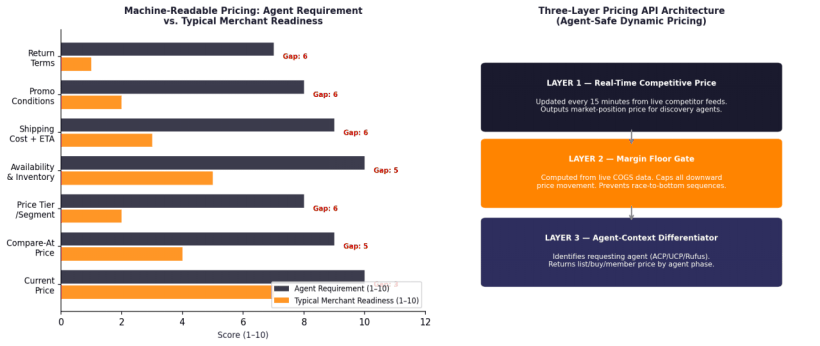
Figure 4 (left): Agent requirement score vs. typical merchant readiness across the seven required pricing data points (scored 1–10). The largest gaps are in promotional conditions, return terms, and price tier structure — precisely the fields that differentiate McKinsey Level 4 agent decision-making from basic comparison. Figure 4 (right): Three-layer pricing API architecture for agent-safe dynamic pricing: real-time competitive layer (15-min refresh), margin floor gate (COGS-computed), and agent-context differentiator (platform-aware price response).
5. Strategic Pricing Frameworks for the Agent-First Era
Traditional pricing strategy is built around human psychology: anchoring, decoy pricing, charm pricing ($9.99), scarcity signals, and promotional sequences. None of these mechanisms function on AI agents. Agents do not feel anchored to a reference price. They calculate.
| Pricing Dimension | Human-Optimised (Legacy) | Agent-Optimised (Required) |
|---|---|---|
| Price Display | Charm pricing, visual hierarchy, font size manipulation | Clean numeric fields, accurate compare-at, no decorative formatting |
| Promotional Logic | Urgency messaging ("Only 3 left!"), countdown timers | Structured discount objects with machine-parsable expiry and conditions |
| Price Comparison | Curated competitor comparisons on landing pages | Real-time price API consistency — agents cross-check against live competitor feeds |
| Loyalty / Tiering | Points multipliers with emotional framing | Structured eligibility fields: member_price, agent_price, loyalty_tier, threshold_conditions |
| Total Cost Communication | Shipping revealed at checkout (deliberate friction) | Shipping + tax + fees in feed — agents compute total landed cost before recommendation |
5.1 The Dynamic Pricing Guardrail Architecture
Dynamic pricing in the agentic era introduces a new risk: price wars at machine speed. Amazon's AutoBuy feature automatically purchases when prices drop below a user-set threshold. If competitors set similar agent-enforced thresholds, the result is a cascade of algorithmic price reductions with no human in the loop to halt the race to the bottom.
McKinsey's 2026 Global Retail AI Index indicates that enterprises integrating agentic pricing models see an average 22% gross margin improvement — but this figure assumes intelligent floor pricing is embedded in the dynamic pricing logic. Without minimum margin guardrails, dynamic pricing APIs exposed to agent queries can trigger margin-destructive sequences.
A machine-readable pricing API should implement three layers: (1) a real-time competitive price layer, updated every 15 minutes; (2) a margin floor layer, computed from live COGS data, that caps downward movement; and (3) an agent-context layer, differentiating price responses based on the requesting agent's platform — returning a list price to a discovery agent and a buy price (with promotion applied) to a checkout agent.
5.2 Agent-Differentiated Pricing: The Emerging Frontier
One of the least-discussed implications of multi-protocol agent commerce is the technical feasibility of agent-differentiated pricing. Just as B2B merchants offer different price tiers to buyer segments, the protocol infrastructure now technically enables different price responses to different agent contexts. When an ACP request arrives from ChatGPT, the merchant's API knows the requesting agent. A pricing system that identifies the requesting agent could return: a standard retail price to discovery-phase agents (optimising for visibility); a competitive price to comparison-phase agents (optimising for selection); a margin-optimised price to checkout-phase agents (capturing maximum margin from high-intent, low-price-sensitivity completion events).
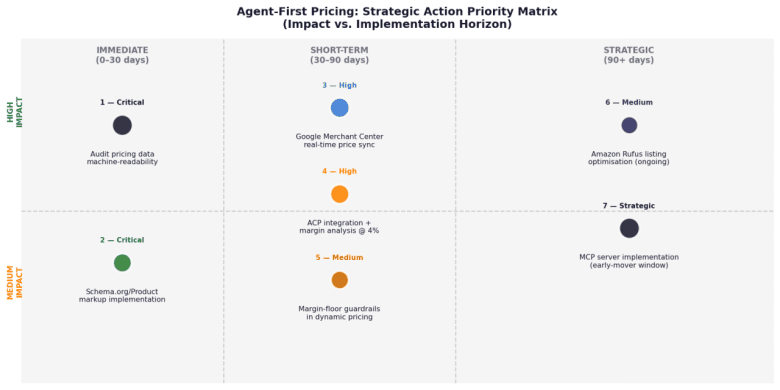
6. Action Roadmap for Pricing Teams
The agentic commerce transition is not a future scenario to plan for. It is a present-state market reality with measurable revenue consequences. The following framework structures the actions pricing teams should take in 2026.
| Priority | Action | Impact Horizon | Complexity |
|---|---|---|---|
| 1 — Critical | Audit pricing data for machine-readability: price, compare-at, availability, shipping, and promo fields must be structured and API-consistent | Immediate | Low–Medium |
| 2 — Critical | Implement schema.org/Product markup across all product pages (covers Perplexity, Google, and open-web agents) | 30 days | Low |
| 3 — High | Connect to Google Merchant Center with real-time price sync — lowest-cost path to UCP compliance | 60 days | Low |
| 4 — High | Evaluate ACP integration for ChatGPT channel — run margin analysis at 4% platform fee + 2.9% payment processing before committing | 60–90 days | Medium |
| 5 — Medium | Build margin-floor guardrails into dynamic pricing logic before exposing price APIs to agent queries | 90 days | Medium |
| 6 — Medium | Monitor Amazon Rufus listing performance as proxy for agent-readability: title, bullets, A+, and structured attribute completeness | Ongoing | Low |
| 7 — Strategic | Evaluate MCP server implementation for real-time, contextual pricing responses to agent queries — early-mover advantage window is open | 6–12 months | High |
Conclusion: The Price Is Right — Only If the Agent Can Read It
Agentic commerce is not coming. It is here. Amazon's Rufus drove $12B in incremental sales in 2025. Black Friday AI traffic surged 805%. Three independent research organisations converge on $190B to $1T in agent-mediated U.S. commerce by 2030. The transaction mechanics analysed in this article reveal a consistent underlying truth: the competitive advantage in agentic commerce is not lower prices. It is structured prices. The merchant who wins the agent-first era is not necessarily the cheapest. They are the most machine-legible. Their pricing data is structured, real-time, API-consistent, and protocol-compliant. Their dynamic pricing logic has margin floors that prevent algorithmic race conditions. Their promotional logic is parseable, not performative
- McKinsey Global Retail AI Index 2026 / "The Automation Curve in Agentic Commerce," January 2026
- Bain & Company — Consumer Behavior and Trust in AI Commerce, 2026
- Morgan Stanley AlphaWise Consumer Intelligence, 2025
- Adobe Analytics — Black Friday / Cyber Monday 2025 Digital Commerce Report
- OpenAI Agentic Commerce Protocol (ACP) Documentation, 2025–2026
- Amazon Q4 2025 Earnings Release and Rufus Performance Disclosure
- Google NRF 2026 — Universal Commerce Protocol Announcement
- Perplexity Merchant Program Documentation
- New York S 3008 — Algorithmic Pricing Disclosure Act (effective July 2025)
- EU Digital Fairness Act Consultation, July 2025
- The World Cup Will Break Your Pricing. Are You Ready?
- The Third-Party Delivery Margin Trap
- The Always-On Shelf: How Real-Time Competitive Data Is Rewriting Retail Pricing
- Why Most Grocers Leave 200–300 bps on Perishables—and What the Digital Product Passport Will Force Them to Fix
- The Always-On Shelf: How Real-Time Competitive Data Is Rewriting Retail Pricing
- The Third-Party Delivery Margin Trap
RapidPricer helps automate pricing and promotions for retailers. The company has capabilities in retail pricing, artificial intelligence, and deep learning to compute merchandising actions for real-time execution in a retail environment.