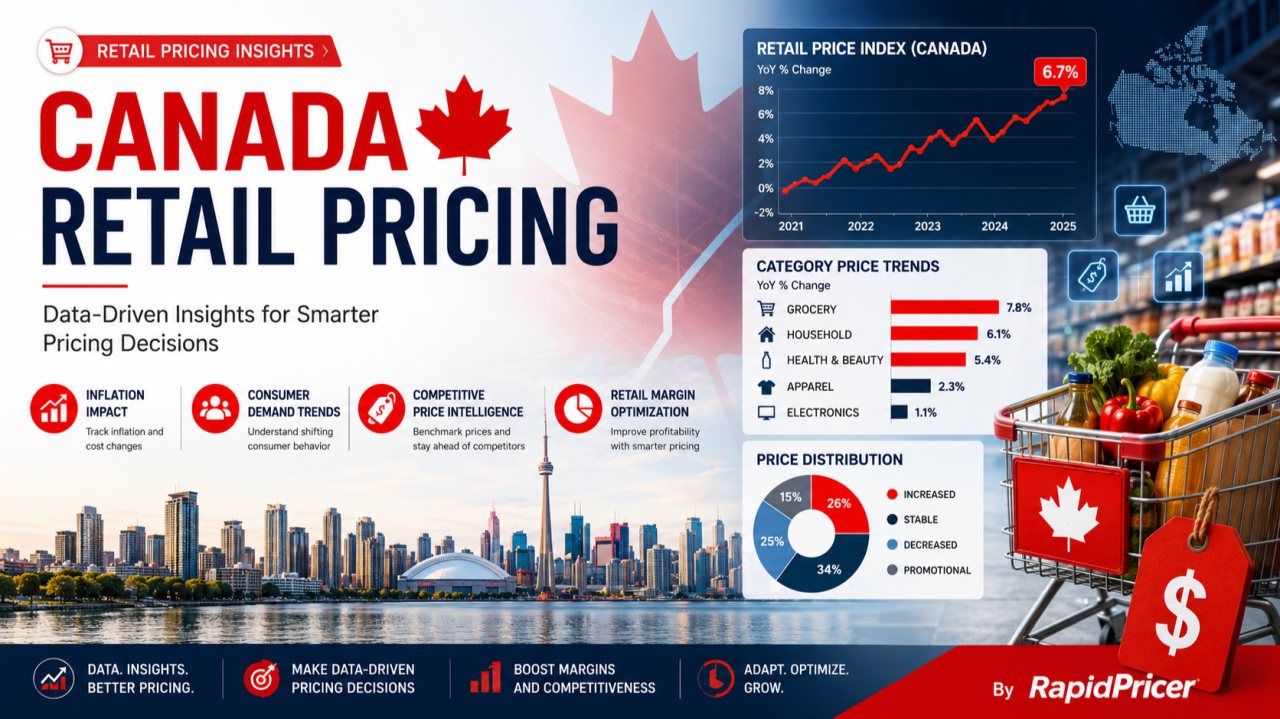
Ask most Canadian retail leaders where their next point of margin is coming from, and you'll hear about sourcing, shrink, labour, or store productivity. All real. But the fastest, lowest-capital lever sitting in almost every retailer's business is the one they touch least scientifically: price.
After 21 years working on retail pricing across grocery, convenience, drug, and general merchandise — and deployments now running across 20,000+ stores — I've come to a blunt conclusion. The retailers who win the next few years won't be the ones with the cleverest promotions. They'll be the ones who stop guessing on price and start treating pricing as a continuous, data-driven discipline.
Canada makes this especially urgent.
The Canadian squeeze is a pricing problem in disguise
Canadian retailers are operating in one of the tougher environments in the developed world right now:
- Cost volatility from every direction — currency swings, cross-border trade and tariff uncertainty, and freight all feed straight into landed cost, often faster than retail prices can react.
- A cautious, value-hunting shopper who trades down, splits the basket across banners, and compares prices on their phone in the aisle.
- Intense public and political scrutiny on prices, particularly in grocery, where every price move is watched.
- A fragmented market — regional cost structures, provincial tax differences, dense urban competition versus thin rural coverage, and bilingual markets that don't behave identically.
Each of these is usually managed in isolation. But they share a single pressure point:
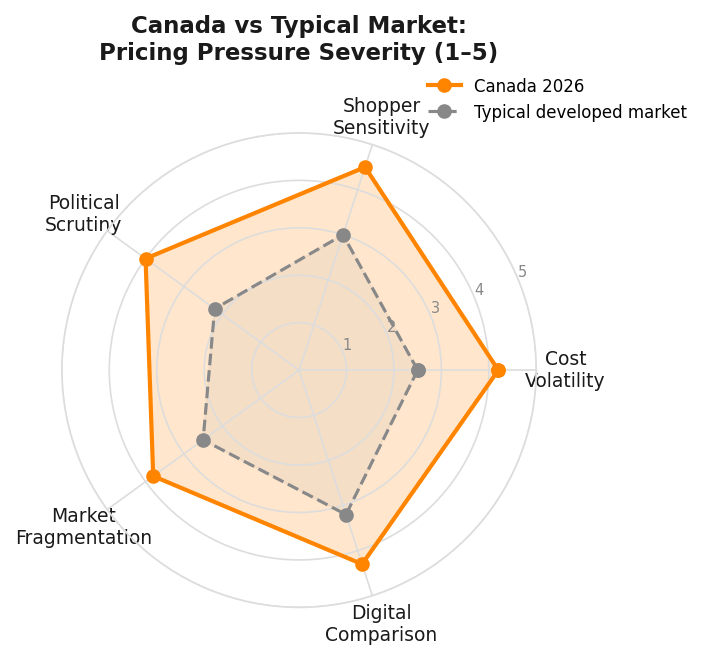
When costs move weekly and shoppers compare instantly, a pricing process built on quarterly reviews, copy-last-year promo calendars, and gut-feel markdowns quietly leaks margin every single day.
The hidden cost of "good enough" pricing
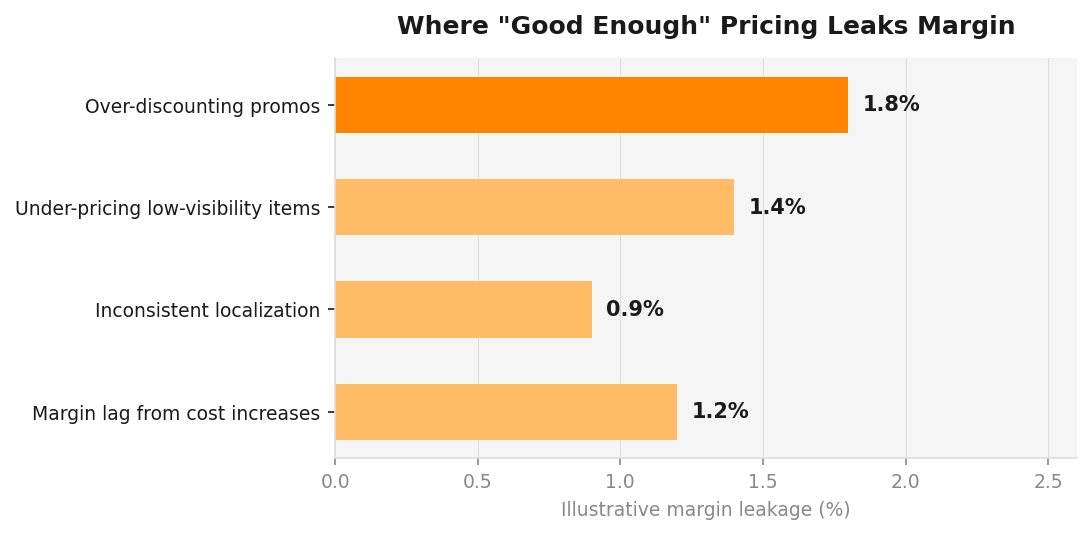
Here's what "good enough" pricing actually costs a Canadian retailer:
- Over-discounting on items that would have sold anyway. Promotion is the most expensive marketing a retailer runs, and a surprising share of it subsidizes demand that didn't need a discount.
- Under-pricing on low-visibility items where shoppers have no reference price and would happily pay more.
- Margin lost in the lag between a cost increase and the shelf-price response.
- Inconsistent localization — charging the same price in a high-competition urban corridor as in a captive rural store, leaving money on the table in one and losing trips in the other.
None of these show up as a single line on the P&L. That's exactly why they persist.
From periodic repricing to continuous retail intelligence
The shift I'd urge every Canadian retailer to make is from episodic pricing to retail intelligence as a continuous capability — pricing, promotion, and markdown decisions informed by data and refreshed continuously, not in occasional sprints.
In practice that means:
- Elasticity-aware pricing — knowing which items are genuinely price-sensitive (the "known value items" shoppers anchor on) and which aren't, then protecting image on the former and recovering margin on the latter.
- Localized to the trade area — prices and promotions that reflect real competition, demographics, and cost-to-serve at the store or cluster level, not one national rule.
- Promotion discipline — measuring true incremental lift so the promo budget funds demand that wouldn't otherwise happen, instead of cannibalizing full-price sales.
- Cost-responsive — shelf prices that react to landed-cost moves in days, not quarters, with guardrails so nothing breaks brand or compliance.
- Competitor-aware, not competitor-led — watching the market without surrendering your margin strategy to a race to the bottom.
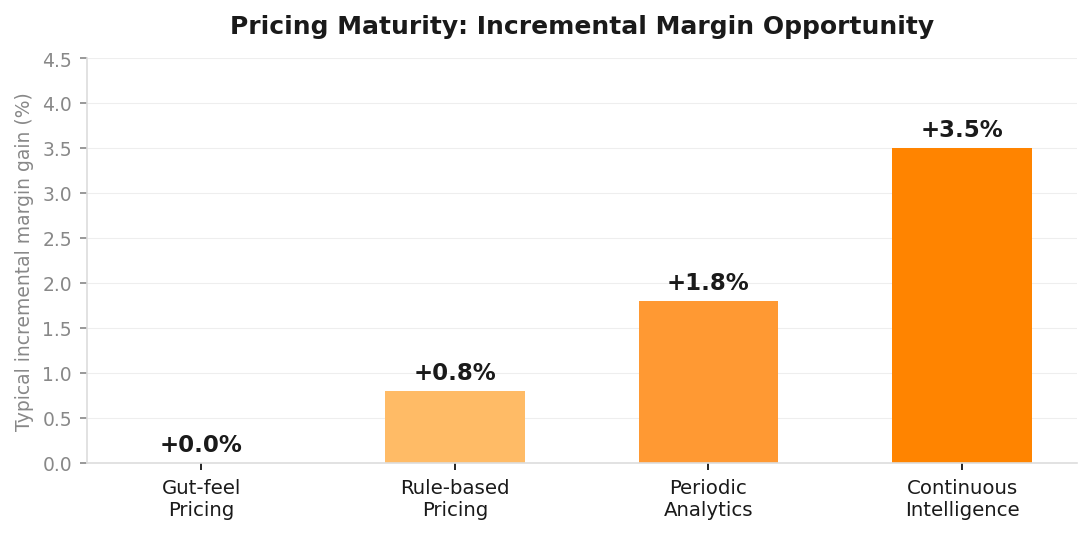
The technology to do this is no longer experimental. AI-assisted pricing can now read demand signals, costs, competitor moves, and inventory together and recommend the price and promotion for each item, in each store, continuously — with humans setting the strategy and guardrails and the system doing the heavy lifting. The retailers seeing the gains aren't replacing their pricing teams; they're giving them a far better instrument to play.
| INSERT · LOCALIZE FOR CANADAChris — this is a natural spot to drop in a Canadian data point or two if you have them: a grocery-inflation stat, a Retail Council figure, or a regional example. It localizes the piece and strengthens the pitch to the Council's publication. |
|---|
What this is worth
In our deployments, even a disciplined first pass at pricing and promotion typically protects or recovers a few points of margin — and in retail, a few points of margin is often the difference between a flat year and a good one. One of our recent multi-year retail engagements closed its first fully profitable year with a meaningful margin improvement driven primarily by smarter pricing and promotion, not cost-cutting.
For a Canadian retailer, the appeal isn't just the upside. It's defensibility: when prices are scrutinized, being able to show that pricing is rigorous, localized, and evidence-based is a far stronger position than "that's roughly what we've always charged."
Where to start
You don't need a multi-year transformation to begin. The most useful first step is usually a pricing health check — a focused diagnostic of where margin is leaking across pricing, promotion, and markdown, and what it would take to capture it. It's low-risk, it's fast, and it tells you whether the bigger prize is worth chasing before you commit to anything larger.
Canadian retail doesn't lack ambition or talent. What it often lacks is the instrument to price with the precision the market now demands. In 2026, that instrument is no longer a luxury — it's table stakes.
Kiran Gange is Founder & CEO of RapidPricer, an AI-driven retail pricing platform deployed across 20,000+ stores worldwide, and author of The Expert Guide to Retail Pricing (Routledge). He works with retailers internationally on pricing strategy and AI-assisted execution.
The PPWR Countdown: What the EU Packaging Regulation Does to Your Shelf Price