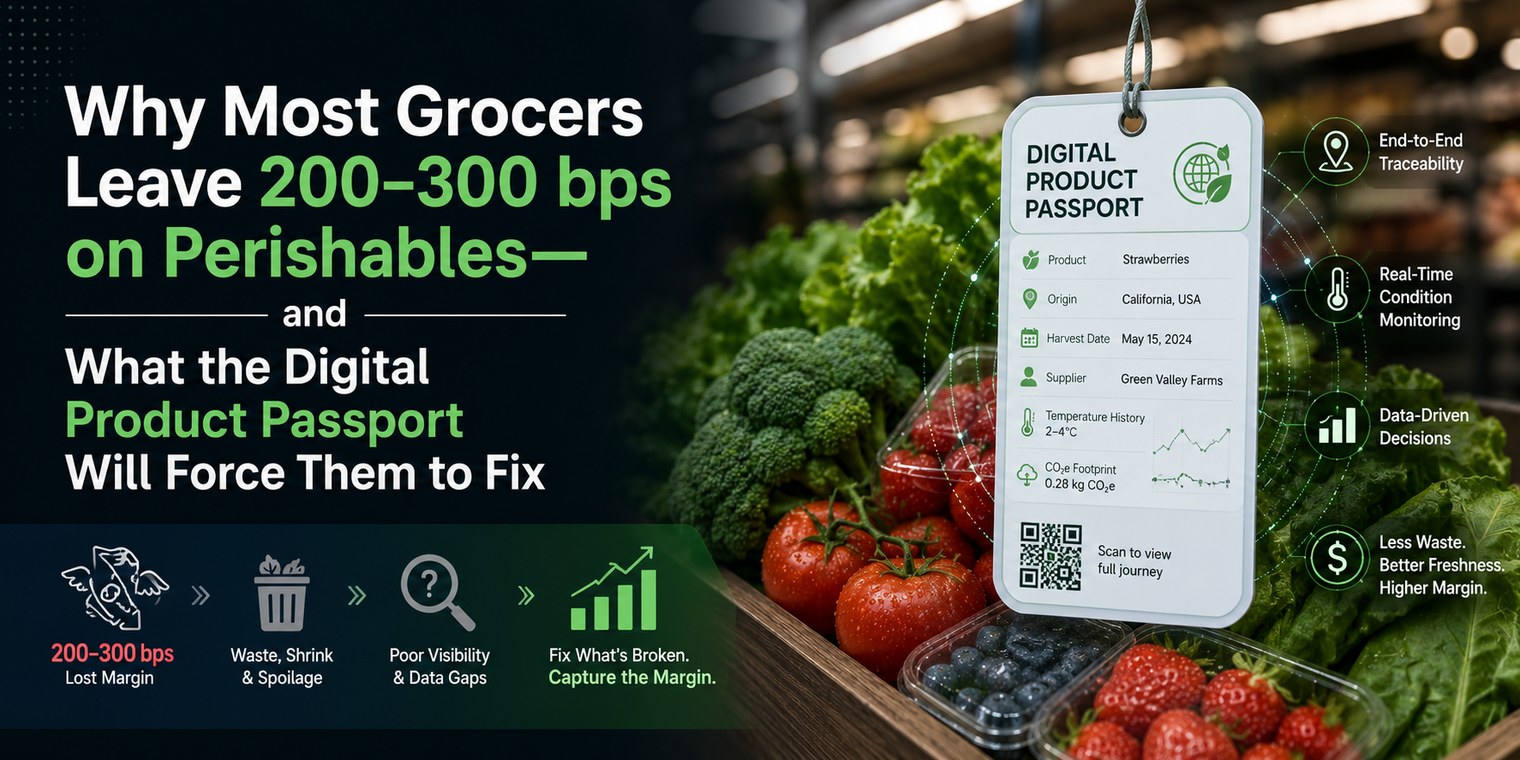
Your supermarket is throwing away £5–8 million in recoverable margin every year.
The EU just started a countdown to when that becomes public.
“Most grocers manage perishable markdowns the same way they did in 1998: one big 50% cut in the last 24 hours, then a clearance slash. That single habit costs a £200m-revenue operator 200–300 basis points of gross margin every year — and the incoming Digital Product Passport will make every wasted unit auditable.”
| | | | | :-: | :-: | :-: | | **28%**of perishable units wasted under the standard two-step markdown | **9%**waste rate achievable with continuous markdown optimisation | **+230 bps**gross margin improvement per store, annualised |
Here's what's actually happening on the shop floor
Walk into almost any mid-market supermarket at 5pm and you'll see the same thing: a wave of yellow stickers appearing on fish, meat and dairy all at once. That's not a pricing strategy — it's a shift-end ritual. Category managers set markdown rules years ago, store staff apply them mechanically, and nobody has seriously interrogated whether they're actually optimal.
The standard playbook looks like this: hold full price until roughly 24 hours before the best-before date, then drop to 50%. If stock remains 12 hours later, cut to 20% of original price. Anything left at close gets written off.
It's operationally convenient. It's also, according to three decades of perishable pricing research, about as far from optimal as you can get.
“The core problem: starting your markdown too late means you never generate enough early demand to sell through the inventory — so you combine margin erosion *and* waste at the same time. A gentler, earlier discount trajectory avoids both.”
The numbers behind the margin gap
The chart below overlays two price paths for a 5-day chilled product. The standard grocer holds full price almost until expiry, then crashes it. The optimal trajectory starts a modest decline around Day 2.75 — and by doing so, sells 91% of stock versus the standard 72%, while recovering £3.95/kg versus £3.61/kg average realised price.
*Source: author model based on Chen & Federgruen (2000); price elasticity −1.8 (Andreyeva et al., 2010); calibrated to UK chilled proteins.*
| | | | | | :-: | :-: | :-: | :-: | | **Metric** | **Standard grocer** | **Optimal markdown** | **Difference** | | Units sold | 72% | 91% | +19 percentage points | | Average realised price | £3.61 /kg | £3.95 /kg | +£0.34 /kg | | Weekly revenue (50t store) | £129,960 | £179,725 | +£49,765 | | Weekly waste write-off | £19,320 | £6,205 | −13,115 saved | | Annualised gross margin gain | — | +£3.3m | ≈ +230 bps |
*Tesco (2023 Annual Report) discloses £115m in food waste. Carrefour’s Sustainability Report implies approximately €210m in perishable write-offs. Both figures are almost certainly understated — they capture write-off costs, not the margin erosion from late markdowns that did sell.*
*“Most grocers aren’t running a markdown strategy. They’re running a waste-disposal schedule with a discount attached.”*
Why this is about to get a lot harder to ignore
The EU’s Ecodesign for Sustainable Products Regulation (ESPR) introduces the Digital Product Passport — a machine-readable record that travels with every product, carrying provenance, environmental data, and critically for food: real-time remaining shelf life. For grocers, three things change simultaneously.
| | | | :-: | :-: | | **2024** | ESPR framework adopted. The legal foundation for Digital Product Passports across all EU product categories is in place. | | **2025** | Textiles DPP goes live. First mandatory passports in the market — sets the implementation template for all sectors to follow. | | **2026** | Batteries & electronics mandated. DPP scope expands rapidly. Food & agriculture confirmed as a priority category in the ESPR Work Plan. | | **2027–28** | Grocery delegated act finalised. Product-specific rules for fresh produce and chilled proteins published. The 2–3 year compliance clock starts ticking. | | **2029–30** | Full grocery DPP compliance required. Store-level waste becomes auditable, line-item visible in statutory CSRD disclosures, and readable by ESG analysts and acquirers. |
1. Waste becomes externally auditable. Today, “food waste” in a sustainability report is a number a comms team has reviewed. Post-DPP, it’s a data trail generated automatically at unit level — per SKU, per store, per week. Acquirers and regulators can interrogate the detail.
2. The data infrastructure for dynamic pricing is already built. The DPP solves the hardest sub-problem: knowing the true remaining shelf life of every unit on the shelf without a manual audit. Add existing POS data and a basic price model, and you have everything needed to run continuous markdown optimisation.
3. ESG metrics become a valuation input. Under CSRD, large EU grocery groups already disclose food waste KPIs. When those KPIs become unit-level auditable, the difference between a 28% waste rate and a 9% rate shows up in sustainability scores — and in PE exit processes.
*Sources: Tesco Annual Report 2023; Carrefour Sustainability Report 2023; IGD Grocery Retail Economics 2024; WRAP 2023; author estimates.*
What good looks like — and how fast you can get there
The grocery operators ahead of this are connecting three data sources: DPP shelf-life feeds from suppliers, real-time stock levels from their warehouse management system, and historical price-demand curves from the checkout. The markdown engine sits on top and updates electronic shelf label prices hourly — that’s enough frequency for any perishable category.
The build timeline is 18–24 months for a retailer starting from scratch. Which is exactly the lead time before the DPP compliance window opens. Operators who start now arrive at 2027 with a working system and two years of margin recovery already banked. Those who wait will build the same system under regulatory pressure, at higher cost, with none of the upside period.
| | | :-: | | For a PE-backed grocery portfolio generating **£1bn in perishable revenue**: a 200–300 bps improvement is worth **£20–30m in annual EBITDA** — a meaningful multiple expansion lever, and a clean ESG narrative, ahead of any exit process. |
The bottom line
This isn’t a technology problem or a data problem. The data exists. The research is 25 years old. The tools are available. It’s an organisational inertia problem — and the DPP is the regulatory event that finally forces the conversation into the boardroom.
Grocers who treat dynamic perishables pricing as an operational detail will spend the next five years watching that detail become a headline disclosure. Those who treat it as a margin recovery and ESG alignment opportunity have a narrow window to act first.