
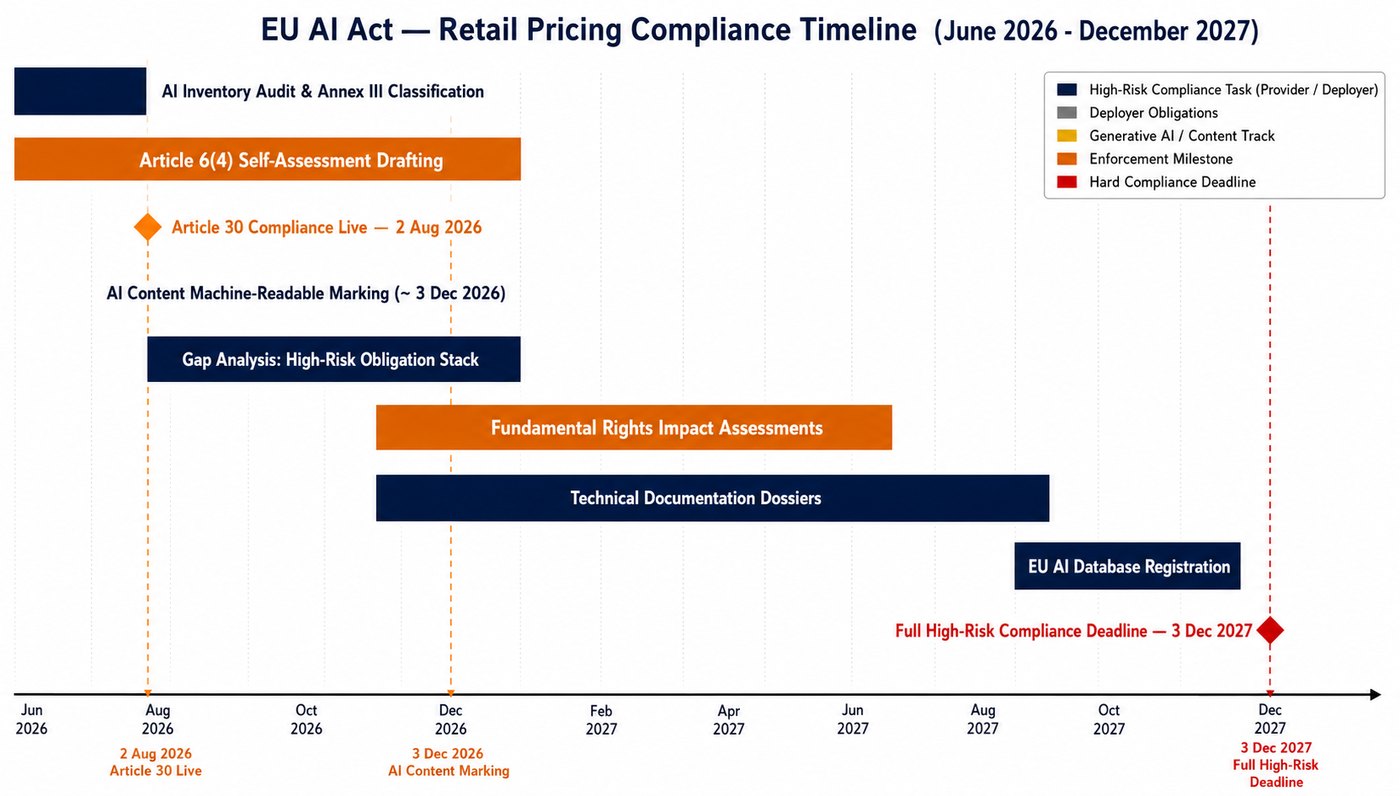
| ⚠ Two Critical Dates You Cannot Confuse 2 August 2026 — Article 50 transparency obligations go live. No extension. Applies to all AI systems, including minimal-risk deployments. 2 December 2027 — High-risk Annex III compliance deadline (Omnibus agreement, 7 May 2026). This is the extended date for most pricing AI in the high-risk tier. |
|---|
1. The Date That Moved — and the One That Did Not
The Digital Omnibus on AI (political agreement, 7 May 2026) extended the compliance deadline for high-risk Annex III AI systems from 2 August 2026 to 2 December 2027 — a 16-month extension. For high-risk AI embedded in regulated hardware products under Annex I, the deadline extends further to 2 August 2028.
That extension does not, however, mean the statute book is quiet until late 2027. 2 August 2026 remains a live enforcement date. Article 50 transparency obligations become fully applicable from that date across a wide population of AI systems — including systems that are not classified as high-risk. In parallel, the Commission published draft classification guidelines on 19 May 2026 (consultation closed 23 June 2026), signalling how it intends to draw the boundary between high-risk and non-high-risk.
2. How the EU AI Act Classifies AI: The Four-Tier Structure
The Act organises AI systems into four risk tiers. The critical variable is not algorithmic sophistication — the Act is explicit that risk classification follows use case, not model architecture.
| Risk Tier | Classification Criterion | Implications for Retail AI |
|---|---|---|
| Unacceptable | Prohibited outright | Not applicable — social scoring, biometric surveillance. No retail pricing system should approach this tier. |
| High Risk | Listed in Annex III; or any AI with individual profiling that fails the Article 6(3) filter | Individual-level personalised pricing, WTP inference, loyalty-tier dynamic pricing, where customer data drives the output price. |
| Limited Risk | Transparency obligations only (Article 50) | AI chatbots, recommendation engines, product description generators, and pricing query assistants. |
| Minimal Risk | Unregulated | Category-level and SKU-level dynamic pricing driven by market signals, competitor data, demand, and time-of-day. |
3. Where Does a Retail Pricing Engine Actually Land?
Most vendors and retailers are getting this wrong — either by over-classifying and panicking, or by under-classifying and assuming they are unaffected. The answer depends entirely on what the system does with individual-level data.
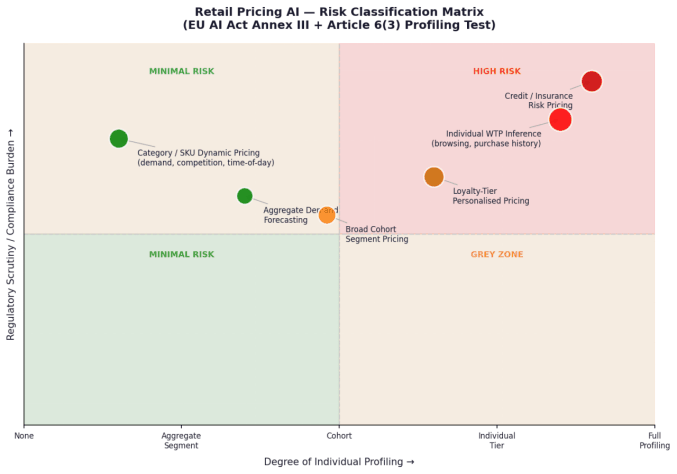
The key analytical distinction is whether the system prices products or prices individuals. A pricing engine that moves the shelf price of olive oil or running shoes based on competitive intelligence and inventory levels does not fall inside Annex III. A system that offers a different price to an identified customer based on their purchase history, inferred willingness to pay, or browsing behaviour crosses the profiling line defined in GDPR Article 4(4) — and with it, the Article 6(3) filter is unavailable.
Table 1 — Retail Pricing AI: Risk Classification by System Type
| Pricing System Type | Individual Profiling? | Risk Classification | Key Obligations |
|---|---|---|---|
| Category / SKU dynamic pricing (demand, competition, time) | No | Minimal Risk | None (Article 50 only if AI-generated content) |
| Segment-based cohort pricing (broad groupings) | Partial — depends on granularity | Grey Zone | Article 6(4) self-assessment required; document and register |
| Individual personalised pricing (loyalty tier, browsing, WTP) | Yes | HIGH RISK | Full Annex III + Articles 9, 11–14, 17, 27, 49, 73 |
| Insurance / credit risk pricing (Annex III, Points 5b–5c) | Yes (explicit) | HIGH RISK | Full obligation stack; third-party conformity assessment may apply |
4. The Profiling Tripwire: Where the Article 6(3) Filter Fails
Article 6(3) of the Act provides a mechanism — the "filter" — that can exempt an otherwise Annex III system from high-risk classification if it performs only a narrow procedural task, improves a previously completed human activity, or operates as a preparatory tool. There is, however, one condition from which the filter cannot save you: profiling of natural persons.
The Commission's May 2026 draft guidelines confirm this is a hard stop. A system that engages in profiling — as defined by GDPR Article 4(4): any automated processing of personal data to evaluate personal aspects relating to a natural person, including behaviour, preferences, economic situation, or location — cannot use the Article 6(3) filter to escape high-risk classification, regardless of how limited its other functions appear.
| Key Finding: The Modular Architecture Trap The Commission's guidelines (and Bird & Bird analysis) confirm that combining AI components in a modular architecture does not help. Where several AI components form a more complex system and their combined purpose or joint outputs materially influence an individual decision, the whole configuration is assessed as a single AI system. A pipeline that keeps the profiling engine "separate" from the pricing engine will not survive regulatory scrutiny if their outputs jointly determine the customer-facing price. |
|---|
5. What Applies from 2 August 2026 — Regardless of Risk Tier
Even if your pricing system is assessed as minimal-risk, Article 50 transparency obligations go live on 2 August 2026. Four obligations matter for retail AI:
| Article | Obligation | What It Means | Retail Example |
|---|---|---|---|
| Art. 50(1) | Chatbot Disclosure | Anyone interacting with an AI chatbot or conversational pricing assistant must be informed that they are interacting with AI. | Pricing query bots, AI product recommendation chat interfaces. |
| Art. 50(2) | Synthetic Content Marking | AI-generated image, audio, or video content must be machine-readable. Visual "AI" label is the interim approach. Grace period to 2 Dec 2026 for systems already live. | AI-generated product imagery, video ads, and AI-narrated promotions. |
| Art. 50(3) | Emotion / Biometric Disclosure | Deployers of emotion recognition or biometric categorisation systems must inform individuals that the system is in operation. | Computer vision footfall analysis, sentiment detection, and shopper behaviour scoring. |
| Art. 50(4) | AI-Text / Deepfake Disclosure | AI-generated content intended to inform the public must be labelled as such. | AI-authored product descriptions, marketing copy, and consumer-facing price communications at scale. |
| Penalty Tier — Article 50 Breaches €15 million or 3% of global annual turnover — not the headline €35M / 7% figure reserved for prohibited AI, but material for any retailer of scale. The Commission has signalled that transparency obligations will be actively monitored from August 2026, not treated as a soft-launch grace period. |
|---|
6. If You Are a High-Risk Deployer: The Full Obligation Stack
If your pricing system involves individual-level personalised pricing that profiles natural persons, you are a deployer of a high-risk AI system once the Omnibus amendments are formally adopted. The obligation structure is divided between providers (the pricing software vendor) and deployers (the retailer).
Table 2 — High-Risk AI Obligation Stack: Provider vs. Deployer
| Obligation | Article | Role | What It Requires in Practice |
|---|---|---|---|
| Risk Management System | Art. 9 | Provider | Continuous, live documentation of risk identification, evaluation, and mitigation across the AI lifecycle — not a one-time assessment. |
| Technical Documentation | Art. 11 + Annex IV | Provider | Full dossier: system design, training data governance, accuracy metrics, known limitations, testing methodology. |
| Instructions for Use | Art. 13 | Provider | Clear documentation of capabilities, performance limits, failure modes, and conditions requiring human oversight — delivered to all deployers. |
| Logging Capability | Art. 12 | Provider | The system must auto-log events sufficient for post-market monitoring and incident investigation by authorities. |
| Human Oversight Design | Art. 14 | Provider | Outputs must not structurally prevent a deployer from overriding or disregarding a recommendation. |
| Conformity Assessment | Art. 43 | Provider | Self-assessment for most Annex III systems; third-party assessment for biometric categorisation systems. |
| EU Database Registration | Art. 49 | Provider | Register before market placement. Article 6(4) self-assessments are also registered; available to national authorities on request. |
| Quality Management System | Art. 17 | Provider | Operational QMS covering design, development, post-market monitoring, and incident reporting. |
| Fundamental Rights IA | Art. 27 | Deployer | Assessment of specific deployment context — customer population, data flows, potential discriminatory impact — before going live. |
| Human Oversight in Operation | Art. 26 | Deployer | Implement the oversight measures specified by the provider; cannot switch to fully autonomous operation. |
| Staff AI Literacy | Art. 4 + Art. 26(4) | Deployer | Personnel supervising AI must have technical knowledge to interpret outputs; an organisation-wide AI literacy programme is required. |
| Incident Reporting | Art. 73 | Deployer | Serious incidents — unexpected discrimination, significant errors in pricing decisions — reported to the national market surveillance authority. |
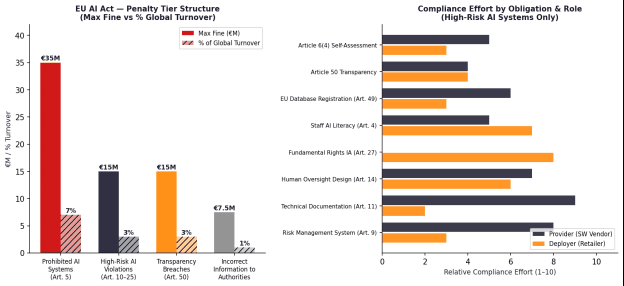
Figure 3 (left): EU AI Act penalty tier structure by violation category. Solid bars show maximum fine in €M; hatched bars show equivalent % of global annual turnover. Figure 3 (right): Relative compliance effort by obligation type and role (provider vs. deployer), scored 1–10. Article 27 fundamental rights impact assessments and staff AI literacy programmes carry the highest deployer burden.
7. The Self-Assessment Obligation Most Vendors Are Missing
One provision deserves particular attention for pricing software companies whose systems could fall under Annex III but who believe they do not meet the high-risk threshold.
Under Article 6(4), if a provider believes their Annex III system is not high-risk, they must document that assessment before placing the system on the market. They are then subject to Article 49(2) registration obligation — meaning the self-assessment must be registered in the EU database. National competent authorities can request the documentation at any time.
| This is not optional — it is a regulatory filing For pricing vendors whose systems sit in the grey zone — segment-level personalisation, loyalty-tier pricing, or systems incorporating any customer behavioural data — the documented self-assessment is likely the minimum compliance step required from 2 December 2027. The May 2026 draft guidelines make clear this assessment must engage seriously with the filter conditions and the profiling exception, not simply assert minimal risk. Regulators will scrutinise marketing materials, product documentation, and actual deployment configurations. If marketing claims "personalised pricing at the individual level," a blanket assertion of minimal risk will not survive. |
|---|
8. The Competitive Dimension: Asymmetric Compliance Costs
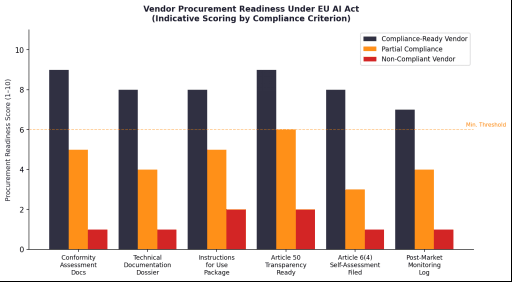
The EU AI Act creates asymmetric compliance costs that will reshape how pricing technology is selected and procured in the EU market. Retailers will increasingly require vendors to produce conformity assessment evidence, technical documentation, and clear instructions for use as part of procurement evaluation. Vendors that have invested in compliance infrastructure will be able to produce this quickly; those that have not will face rushed documentation or lost contracts.
For retailers operating across multiple European markets, the obligation to complete a fundamental rights impact assessment before each new deployment of a high-risk pricing system means geographic rollouts need compliance checkpoints built in. A personalised pricing system deployed in Germany cannot simply be switched on in France without a fresh assessment covering the specific data environment and customer population.
9. What to Do in the Window Before December 2027
The Omnibus extension creates a compliance runway, but the Commission's own guidance frames it as time to build, not time to wait.
| Phase | Required Actions |
|---|---|
| Now – Aug 2026 | Audit your AI inventory. Identify every AI system in your pricing and merchandising stack that touches personal data. Classify each system against Annex III categories, applying the profiling test rigorously. Ensure Article 50 compliance is in place by 2 August 2026. For any system in the grey zone, begin drafting Article 6(4) self-assessment documentation. |
| Q4 2026 | Ensure AI content machine-readable marking is live by 2 December 2026 (Omnibus grace period for generative AI content). Begin gap analysis against the high-risk obligation stack (Articles 9, 11, 12, 13, 14, 17) for any system likely to be classified as high-risk. |
| 2027 (pre-Dec) | Complete technical documentation dossiers. Complete fundamental rights impact assessments (deployers). Register in the EU AI database. Confirm conformity assessment completion. Verify instructions-for-use packages delivered to all deployer customers. |
| The Bottom Line Pricing intelligence that operates on product-level market signals — competitive data, demand, time-of-day, inventory — remains outside the high-risk perimeter. Pricing intelligence that operates on individual-level behavioural profiles — purchase history, inferred WTP, browsing behaviour, loyalty tier as a profiling proxy — sits squarely inside it. The build-versus-buy and configure-versus-customise decisions retailers make in the next 18 months will carry compliance consequences extending well beyond August 2026. |
|---|
- EU AI Act (Regulation 2024/1689)
- AI Act Omnibus political agreement, 7 May 2026
- Commission draft guidelines on high-risk AI classification (Article 6(5)), 19 May 2026
- Commission draft guidelines on Article 50 transparency obligations, 8 May 2026
- artificialintelligenceact.eu — annotated text and commentary
- DLA Piper, Freshfields, Latham & Watkins, Mishcon de Reya — analyses of Omnibus agreement
- Bird & Bird — analysis of May 2026 draft classification guidelines
- The World Cup Will Break Your Pricing. Are You Ready?
- The Third-Party Delivery Margin Trap
- The Always-On Shelf: How Real-Time Competitive Data Is Rewriting Retail Pricing
- Why Most Grocers Leave 200–300 bps on Perishables—and What the Digital Product Passport Will Force Them to Fix
- The Always-On Shelf: How Real-Time Competitive Data Is Rewriting Retail Pricing
- The Third-Party Delivery Margin Trap
RapidPricer helps automate pricing and promotions for retailers. The company has capabilities in retail pricing, artificial intelligence, and deep learning to compute merchandising actions for real-time execution in a retail environment.