
The Always-On Shelf: How Real-Time Competitive Data Is Rewriting Retail Pricing
- mamta Devi
- 1 day ago
- 6 min read


Written By: Gargi Sarma
There’s a particular kind of frustration every retail pricing leader knows. You pull the weekly competitor report on Monday morning, spot a price move that happened six days ago, and spend the next hour working out what it cost you. The data told you everything — just far too late.
That experience is becoming rarer. Not because pricing has got simpler — it hasn’t — but because the underlying data infrastructure has fundamentally changed. The shift from periodic snapshots to continuous, multi-source competitive feeds is quietly reshaping how pricing decisions get made, how fast teams can move, and where margin leaks before anyone notices.
1. The Old Way: Weekly Cycles and Structural Blind Spots
For most retailers, competitive pricing intelligence until recently meant one of two things: a manual process involving someone checking competitor sites on a schedule, or a batch scraping service delivering a feed of prices every 24 to 72 hours. Either way, the rhythm was weekly. Digest on Monday, react by Wednesday, and by Friday conditions had shifted again.
The gaps weren’t just temporal. Coverage was inconsistent — high-volume lines tracked obsessively, long-tail SKUs ignored entirely. SKU matching was a persistent headache: your Samsung 55″ QLED and a competitor’s listing for the same model might carry six different product strings across four retailers. Reconciling those manually, at scale, was expensive and error-prone.
REAL COST OF A 72-HOUR BLIND SPOT
Consider a mid-sized home goods retailer. Their top-selling coffee maker is priced at $89.99. At 10am on a Tuesday, it’s competitive. By 2pm, a key Amazon seller drops to $79.99 with free 2-hour delivery. By 5pm, they’ve lost over a dozen sales they had no visibility on. The weekly batch report surfaces this — on the following Monday. The damage is already done.
The deeper problem was structural. Weekly data makes weekly thinking feel adequate. Teams calibrate their processes to the data they have. If your intelligence has a 72-hour lag, you build workflows that assume a 72-hour lag.
“The cadence of the data becomes the cadence of the organisation — and in a market that moves by the hour, that’s a compounding disadvantage.”
2. What’s Changed: Continuous Feeds, Smarter Matching, Broader Coverage
Three things have shifted in combination to make real-time competitive intelligence practical at scale.
Faster crawling infrastructure. Modern systems can monitor competitor pricing — across product pages, search results, and promotional banners — at refresh intervals measured in minutes rather than days. The practical barrier to continuous monitoring has largely collapsed. Platforms like Intelligence Node now advertise sub-second refresh rates and repositories exceeding 1.2 billion SKUs.
AI-driven SKU matching. Machine learning models trained on product attributes — titles, descriptions, images, GTINs, and structured specifications — can now resolve the same physical product across multiple retailers with high confidence. What previously required manual reconciliation teams now happens programmatically, at the scale that modern assortments demand.
Multi-source aggregation. Where legacy approaches tracked a handful of named competitors, current feeds routinely incorporate marketplace sellers, regional players, and dynamic promotional activity alongside major banners. The competitive set your customers actually price-check is now more legible than it has ever been.

Figure 1: Price change frequency: Amazon makes ~2.5 million changes/day vs. ~50,000/month for major traditional retailers
3. What It Unlocks: Speed, Margin Defence, and Fewer Surprises
The operational benefits are real, but worth being specific about — because “faster data” is not the same thing as “better decisions.”

Figure 2: How shoppers already use price intelligence against retailers: 83% check 2+ stores; 74% abandon carts when a lower price is found elsewhere
Faster reaction windows. For high-velocity categories — electronics, FMCG, seasonal lines — price parity windows can open and close within hours. McKinsey research found that retailers deploying real-time competitive response modules were operational within eight weeks and saw up to 3% increases in both revenue and margins in pilot categories, without sacrificing price image on key value items.
EXAMPLE: ELECTRONICS RETAILER, PEAK SEASON
A UK consumer electronics chain switched from 48-hour batch feeds to a 15-minute refresh cycle before Black Friday 2024. During the event, they detected 23 significant competitor price moves within the first 6 hours of trading — and responded to 18 of them within the same session. In prior years, those moves would have surfaced the following Monday.
Better margin defence. Continuous monitoring makes it easier to distinguish temporary promotional activity from genuine repositioning. That distinction matters enormously: matching a 48-hour flash promotion erodes margin unnecessarily; missing a permanent price shift on a key line risks volume. Real-time data gives you the signal quality to tell the difference.
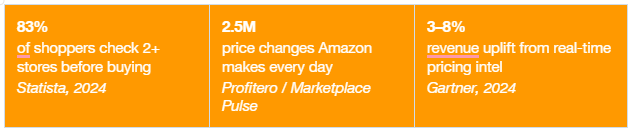
Reduced blind spots. Automated, broad-coverage feeds surface the competitor moves that previously fell through the gaps — the regional player quietly undercutting on a profitable sub-category, the marketplace seller eating into a high-margin line. According to Gartner (2024), retailers investing in robust pricing intelligence reported 3–8% revenue uplift and 1–4% margin improvement by avoiding unnecessary discounting and identifying safe price increases.

Figure 3: Reported uplift ranges from real-time pricing intelligence (Gartner 2024, BCG 2024, McKinsey)
4. What to Watch Out For: Three Risks Worth Taking Seriously
The case for continuous competitive data is strong. But the transition from weekly batch processes to real-time feeds creates its own set of problems, and they’re worth naming plainly.

Figure 4: Illustrative response-time comparison: detecting and acting on a competitor price move, old vs. new
Data quality degrades in new ways. Faster feeds mean more exposure to scraping errors, temporary outages, and mismatched records that haven’t been caught yet. Weekly batch processes were slow but allowed more reconciliation time. Real-time systems need robust validation logic upstream — bad data arriving fast is worse than slow data, because it can trigger automated responses before anyone has checked it. Invest in your matching accuracy before you invest in your refresh rate.
Integration debt accumulates fast. Connecting a real-time data feed to pricing systems built around weekly batch inputs is rarely straightforward. Pricing engines, replenishment systems, and promotional planning tools often assume a particular data rhythm. Retrofitting continuous feeds onto legacy architecture creates latency and consistency problems that can undermine the speed advantage you were trying to gain. Budget integration time as generously as you budget data acquisition.
Signal-to-noise requires active management. More data, more frequently, means more noise. Pricing teams moving from weekly digests to real-time dashboards often report an initial period of alert fatigue — every blip looks like a signal. One category manager, speaking at a 2024 retail technology conference, described cutting their ‘price panic’ meetings by 50% only after they had defined clear escalation thresholds for each category. The organisations that make real-time data work have invested as much in defining what to act on as in the infrastructure itself.
The Real Shift Is Organisational, Not Just Technical
The move to real-time competitive intelligence is not primarily a technology decision. It is a decision about how quickly your organisation wants to be capable of moving, and whether your processes, systems, and governance are built to use faster data rather than be overwhelmed by it.
The retailers making the most of continuous feeds are not the ones with the most sophisticated data platforms. They are the ones who treated the data upgrade as a prompt to redesign their pricing workflows — to ask, seriously, what a two-hour response window changes about how decisions get made and who makes them.
“Amazon adjusts ~2.5 million prices per day. Your customers have apps that track every move. The always-on shelf is already the reality they’re shopping in. The question is whether your pricing intelligence is operating at the same speed.”
The gap between weekly and real-time is not just a gap in data freshness. It’s a gap in competitive posture. For pricing leaders with the appetite to close it, the tools have rarely been more accessible — and the cost of not acting has rarely been more visible.
Sources & Notes
Profitero / Marketplace Pulse (2025): Amazon price change frequency (~2.5 million/day)
Statista (2024): 83% of shoppers check 2+ stores before purchase
Gartner (2024): 3–8% revenue uplift from dynamic pricing intelligence
BCG (2024): 1–4% margin improvement from smarter pricing intelligence
McKinsey: 2–5% sales growth and 5–10% margin improvement from dynamic pricing at scale
Intelligence Node: Product matching accuracy benchmarks and SKU repository data
Figure 4: response times are illustrative, based on industry practitioner benchmarks
"AI-Generated Content Disclaimer
This content was generated in part with the assistance of artificial intelligence tools. While efforts have been made to review, edit, and ensure the accuracy, completeness, and reliability of the content, it may still contain errors or omissions. It should not be considered professional advice, and users should independently verify any information before making decisions based on it. The publisher/author assumes no responsibility or liability for any consequences resulting from reliance on this content."
Read More On
The Pricing DD Blind Spot: How Much Margin Are PE-Backed Food Retailers Really Leaving on the Floor
Retailers Don't Need More Reports. They Need Automated Intelligence
Daypart Pricing: Why Time-of-Day Intelligence Matters as Much in Convenience Retail as in Fast Food
From QSR Menu Boards to Grocery ESLs: Digital Screens as Real-Time Pricing Engines
World Cup 2026: The Pricing Playbook for Retailers and QSRs in Mexico, Canada, and the US
Why Traditional Pricing Software is Dying in Latin America (And What’s Replacing It)
About RapidPricer
RapidPricer helps automate pricing and promotions for retailers. The company has capabilities in retail pricing, artificial intelligence, and deep learning to compute merchandising actions for real-time execution in a retail environment.
Contact info:
Website: https://www.rapidpricer.com/
Email: info@rapidpricer.nl


Comments